
About the Allegheny County Department of Court Records
The Department of Court Records files and maintains court documents for the Allegheny County Court of Common Pleas. It is not a generic county clerk. DCR is built from three core record divisions plus a marriage section. The Civil/Family Division keeps civil and family filings. The Criminal Division keeps adult criminal files. The Wills/Orphans' Court Division keeps estate, marriage, and Orphans' Court records. A marriage license section issues licenses and marriage records.
The office helps the public file and obtain documents through an online e-Filing and Retrieval System. Civil and family records, including divorce filings, run through the Civil/Family Division. The county notes that a Court of Common Pleas case file is requested from DCR, not through a Right-to-Know form, because court case files stay public unless a judge seals them. The contact card shows where to reach the Civil/Family counter, and the broader Civil Division offices sit upstairs in the same building.
DCR – Civil/Family Division
City-County Building, 414 Grant Street, 1st Floor
Pittsburgh, PA 15219
412-350-5729
Mon–Fri 8:30 a.m.–4:30 p.m.
The broader Civil Division courtrooms and staff sit on the 7th and 8th floors of the same building, reachable at 412-350-0591. The 1st floor counter is the public records point.
What the Civil/Family Division Does
The Civil/Family Division receives and maintains filings for the county's civil and family courts. It accepts new cases, logs documents, issues some process, and collects fees. It also runs the online tools that let people file and pull records. The civil work touches arbitration, the Board of Viewers, calendar control, discovery motions, housing court, jury assignment, and general motions.
Civil arbitration here uses compulsory non-binding arbitration with a $50,000 ceiling on damage awards. Family work in this division includes divorce, custody, and support filings. The list below shows the core tasks the division handles for the public.
- File civil and family cases through the e-Filing and Retrieval System.
- Keep dockets and case files for civil and family matters.
- Issue certified copies of civil, family, and marriage records.
- Run the Indices Prior to 1995 search for older civil and family cases.
- Process marriage license applications and marriage record orders.
The county portal splits these tasks across login, search, and apply paths. The next section walks through a certified copy request.
How to Request a Certified Copy
A certified copy is an official copy with a clerk's seal. Courts, banks, and agencies often need a certified copy rather than a plain printout. A docket sheet from the statewide search is not a certified document. For a certified civil, family, or marriage record, you work with the Civil/Family Division. Follow these steps.
- Find the docket number or full party names for the case.
- Pick the right division; civil, family, and marriage records go through Civil/Family.
- Submit the request in person at the 1st floor counter or through the DCR portal.
- Pay the copy and certification fees, plus the records retention fee where it applies.
- Pick up the certified copy or have it mailed to your address.
For civil or family case files, the county says to skip the Open Records Fill-In Form. A Court of Common Pleas case file is requested straight from DCR. Court case files are open to the public unless a judge sealed them.
Plan ahead for a few details. Bring a photo ID and the case number, and be ready to pay by an accepted method. Certified copies cost more than plain copies, and each division posts its own schedule. For older civil or family matters, the Indices Prior to 1995 tool is the place to start, since those cases predate the modern electronic index and may not appear in a routine portal search.
E-Filing and Retrieval System
DCR runs an online portal for filing and pulling records. The Civil/Family side lets users register, log on, search, and reach forms and fee schedules. Attorneys filing civil matters must e-file. That rule took effect November 13, 2023. Self-represented filers are encouraged to e-file but are not required to.
Security on the portal is tight. Dual-factor authentication is mandatory for attorneys, and enrollment needs an email request, a valid government photo ID, a BAR ID, a video call with DCR staff, and a mobile number. The portal also warns that use is monitored and recorded.
Fees are changing in 2026. The records retention fee charged on new filings rises from $3.50 to $7.00 on June 1, 2026, under an administrative order. Retrieval through the portal returns dockets, case information, and many filed documents for registered users, though some records stay gated behind a login or limited by the statewide public-access policy. A registered account also lets a filer track a case and pull copies without a counter visit.
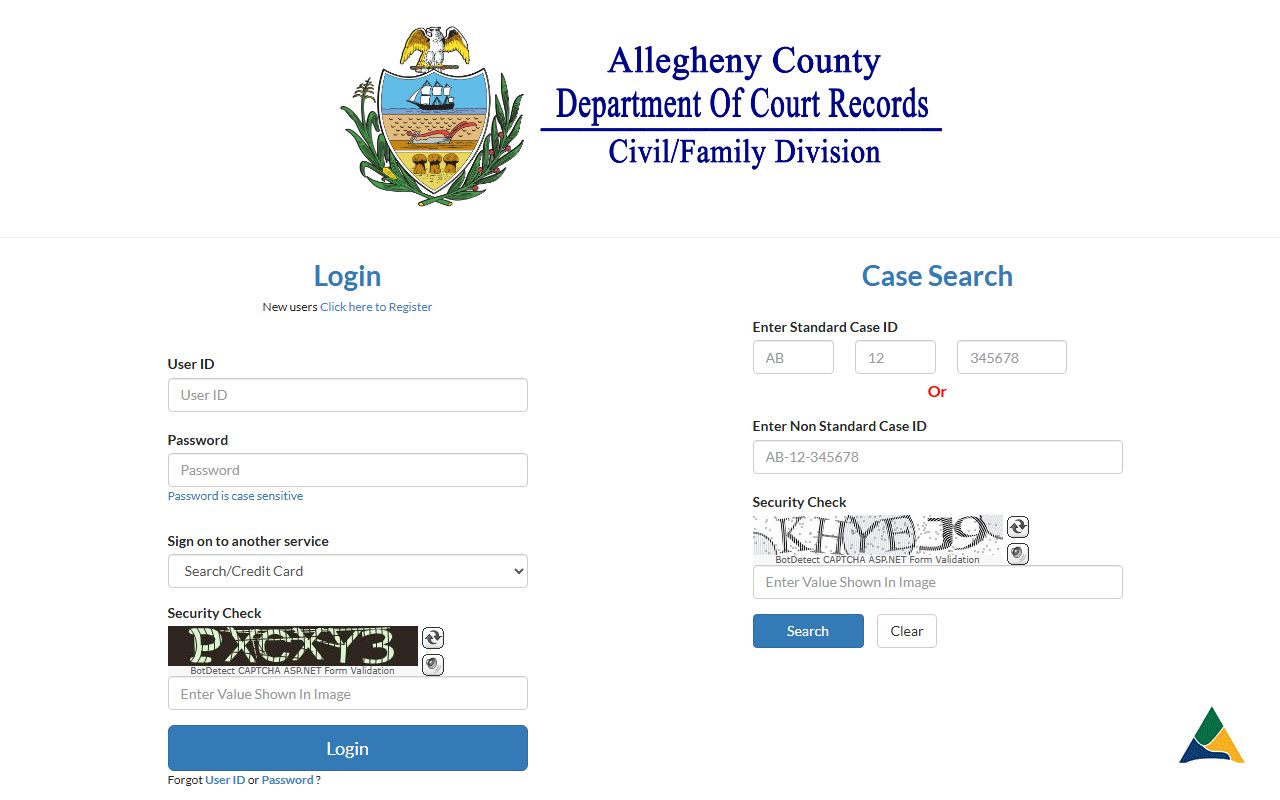
The Civil/Family e-filing and retrieval portal handles registration, search, and record orders.
You can reach it through the DCR Civil/Family portal, the main login and search path for civil and family records.
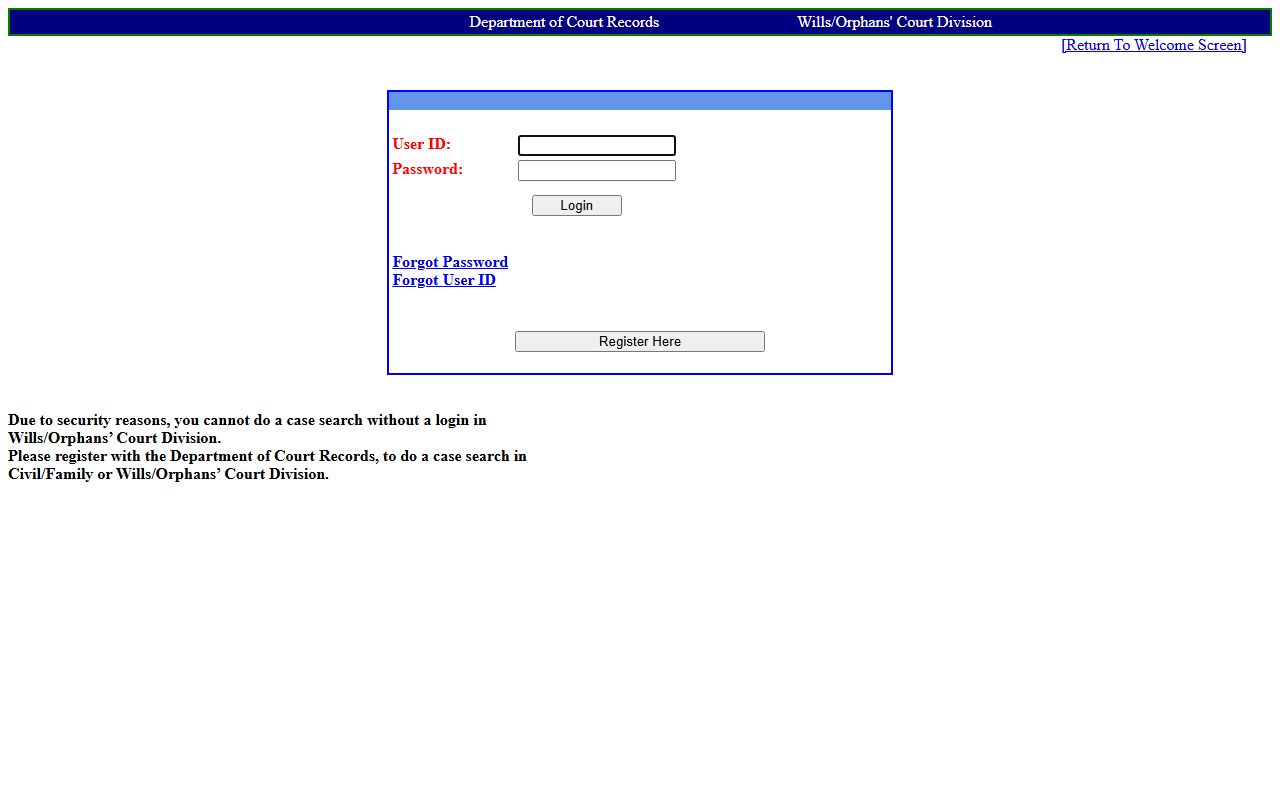
The same DCR system serves the Wills/Orphans' Court side through its own login, which estate and will filers use.
That estate path is the DCR Wills/Orphans portal, with separate logons for ACH and draw-down account users.
Note: Effective July 1, 2026, all case participants with verified email will receive Rule 236 notifications electronically rather than by mail.
Records Request Portal Fields
The DCR portal uses a set of links and actions rather than one long form. You start by choosing the path that matches your need: register, log on, search, or apply. The marriage paths route to the same portal with a marriage flag. The table below lists the main portal actions and what each one does.
| Field / Action | Required | Notes |
|---|---|---|
| Register | For account holders | Civil/Family account creation; Wills/Orphans registration is separate. |
| User Logon | For retrieval | Needed for portal account access and record retrieval. |
| Search | Conditional | Civil/Family search behind the login path. |
| ACH / Draw-Down Logon | For payment accounts | Used by Wills/Orphans ACH and draw-down account holders. |
| Apply for a Marriage License | To start a license | Routes to the Civil portal with the marriage flag set. |
| Search/Order Marriage Records | Optional | Same marriage portal path for ordering records. |
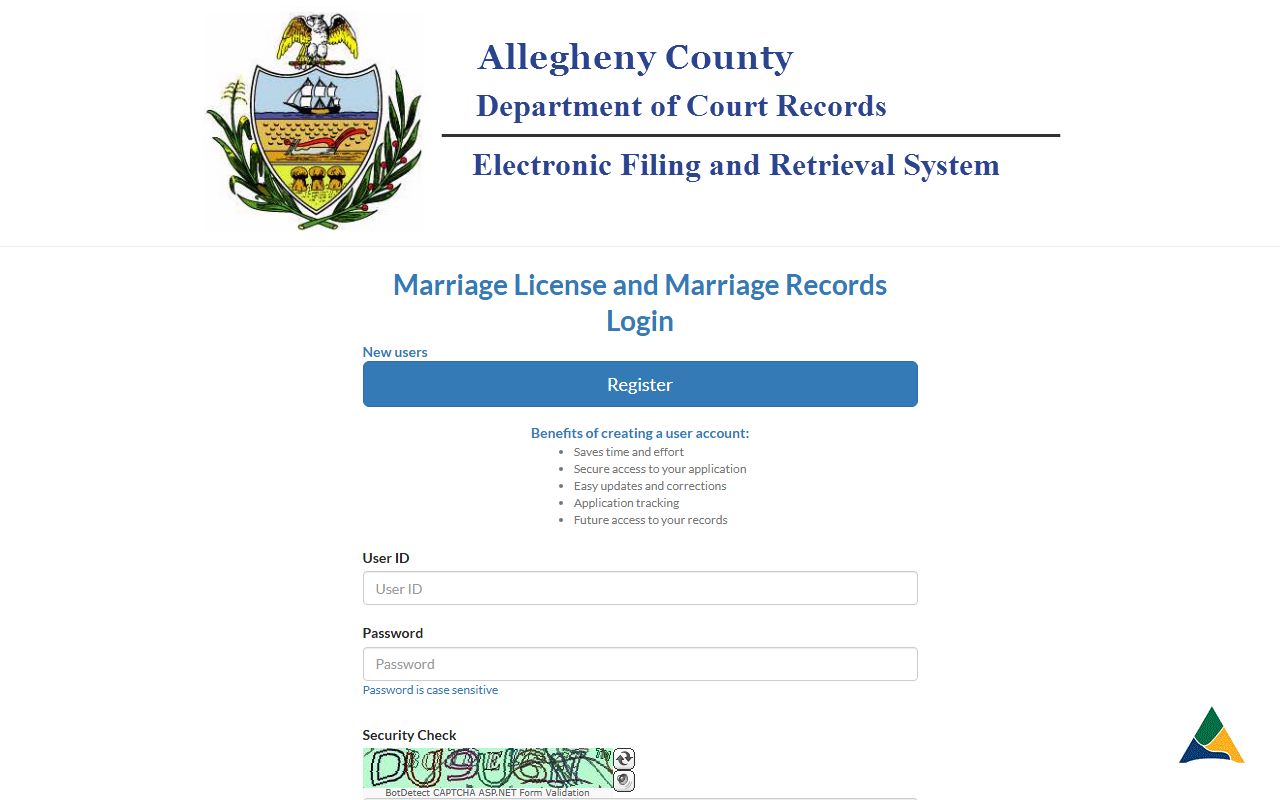
The marriage portal is part of the same DCR system. It handles both applications and record orders.
You can open the DCR marriage records portal to apply for a license or order a marriage record.
For full marriage details and the license process, see the dedicated marriage and divorce records page.
Allegheny County Court Records Fees
Fees depend on the record and the service. The county posts a civil and family fee schedule online, so you can confirm copy and certification costs before a visit. A records retention fee also applies per filing. The table lists the sourced amounts found in this research; check the published schedule for current per-page copy and certification costs, which are not listed here.
| Item | Amount |
|---|---|
| Marriage license application total | $90 |
| Computer fee (part of license total) | $29 |
| Allegheny County fee (part of license total) | $35.50 |
| Certified copy of marriage record | $20 |
| Summary appeal filing fee | $94 |
| Records retention fee (per filing) | $3.50, rising to $7.00 on June 1, 2026 |
The marriage license total of $90 also folds in the Pennsylvania writ tax, a court technology fee, and two state surcharges. The license total is payable by cash or credit card.
Note: The records retention fee rises from $3.50 to $7.00 for all new filings on June 1, 2026, under Administrative Order AD-26-000097-PJ.
Older Records and the Indices Prior to 1995
Not every case lives in the modern system. For older civil and family matters, DCR offers an Indices Prior to 1995 search. This index research path helps when a case predates the current e-filing setup. It points you to the right book or file for a pull.
The county open-records page also lists direct division phone lines so you can confirm where a file sits. Civil and family court records, criminal court records, and Wills/Orphans-Court records each have their own line.
The full guidance is on the Allegheny County court records open-records page, which tells people to request a Common Pleas case file from DCR rather than through a Right-to-Know form.