
How to Search Allegheny County Court Records
The Pennsylvania Unified Judicial System case search is the main public tool. It holds dockets for the Court of Common Pleas, the magisterial district courts, Pittsburgh Municipal Court, and traffic and citation cases. The search is free, and most dockets open without an account. For copies of filed papers, the county Department of Court Records, or DCR, runs an e-filing and retrieval portal split by division.
You need a little information before you start. A full legal name works for a person search. A docket number, citation number, or OTN returns one case fast. The county also explains that a court case file is requested from DCR, not through a Right-to-Know form.
DCR is split into three record divisions. The Civil/Family Division keeps civil and family filings. The Criminal Division keeps adult criminal files. The Wills/Orphans' Court Division keeps estate, marriage, and Orphans' Court records. For older civil and family cases, DCR also offers an Indices Prior to 1995 search for index research that predates the modern system.
The county spells this out on its court-records open-records page, which tells people to skip the Open Records form for a Common Pleas case file.
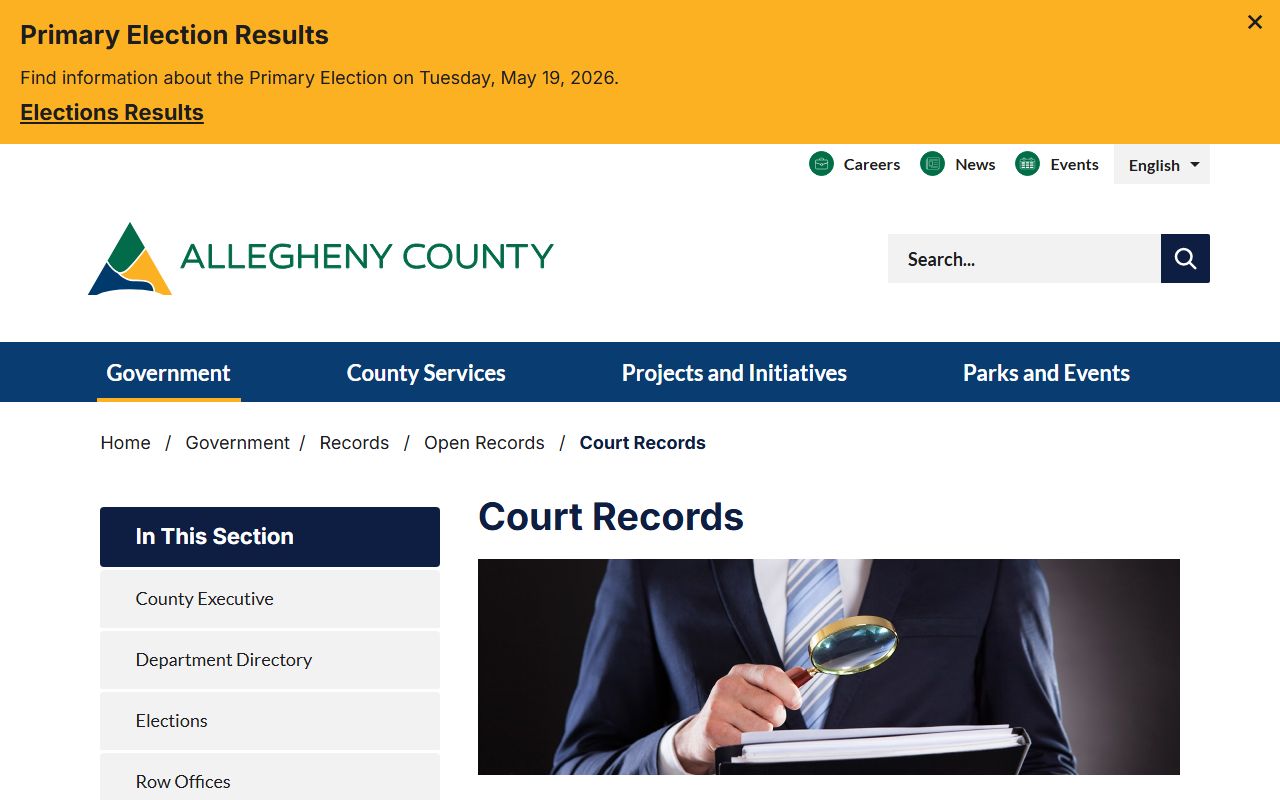
You can read that guidance at the Allegheny County court records page. It lists direct division phone numbers for civil, criminal, and Wills/Orphans files. Follow these steps for a docket search.
- Open the Pennsylvania UJS case search and choose a search type.
- Set the county to Allegheny so other counties drop out of the results.
- Enter the name or number; add a filing date when a name is common.
- Review the court, docket number, parties, status, and events.
- Call or visit the matching DCR division for certified copies.
Allegheny County Court Records Search Fields
The UJS case search gives you several ways to find a case. You pick a search type first, then fill the fields that match. Setting the county is the single best way to keep results local. The table below lists the fields most people use.
| Field Label | Type | Required | Notes / Format |
|---|---|---|---|
| Search By | Tab / radio | Yes | Participant Name, Docket Number, Citation Number, Complaint Number, OTN, Date Filed, and more. |
| Participant Name | Text | Conditional | First and last name; used when no case number is known. |
| Docket Number | Text | Conditional | Use the exact format, such as a CP or MJ prefix. |
| Citation Number | Text | Conditional | For a traffic or summary ticket. |
| County | Dropdown | Strongly advised | Select Allegheny to cut statewide false matches. |
| Date Filed Start / End | Date | Optional | Narrows a name search by date range. |
Common Pleas cases are heard by 43 commissioned judges across the divisions. You can see who hears what on the county judge directory.
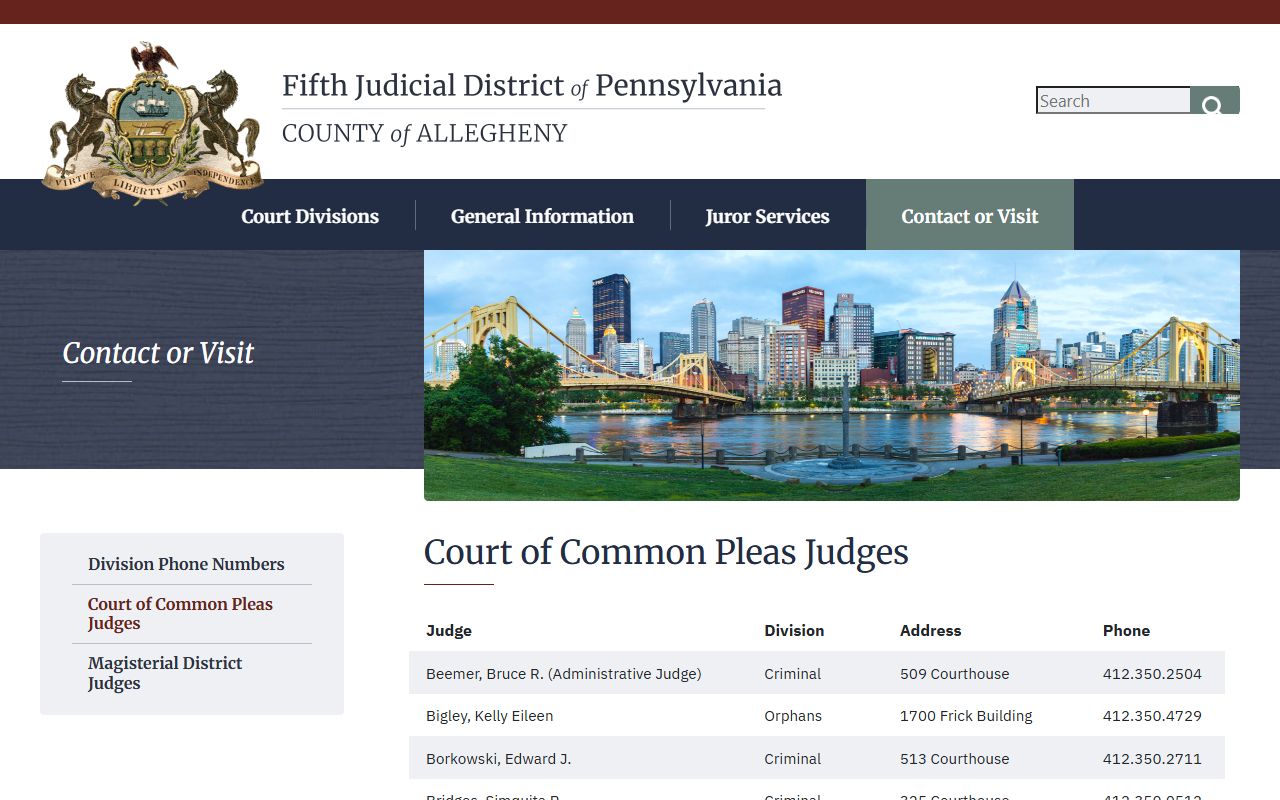
The Common Pleas judge directory lists divisions, courtrooms, and phone numbers. That helps when a docket names a judge and you need the courtroom.
Types of Allegheny County Court Records
Court records here split by division, and each division produces a distinct record. Civil records come from money and property cases. Criminal records track charges and outcomes. Family records hold divorce, custody, and support. Orphans' Court holds estates and guardianships. The minor courts produce traffic, small claims, and landlord-tenant records.
The 46 magisterial district courts handle a big share of local cases. Their official directory lists every office, judge, and address.
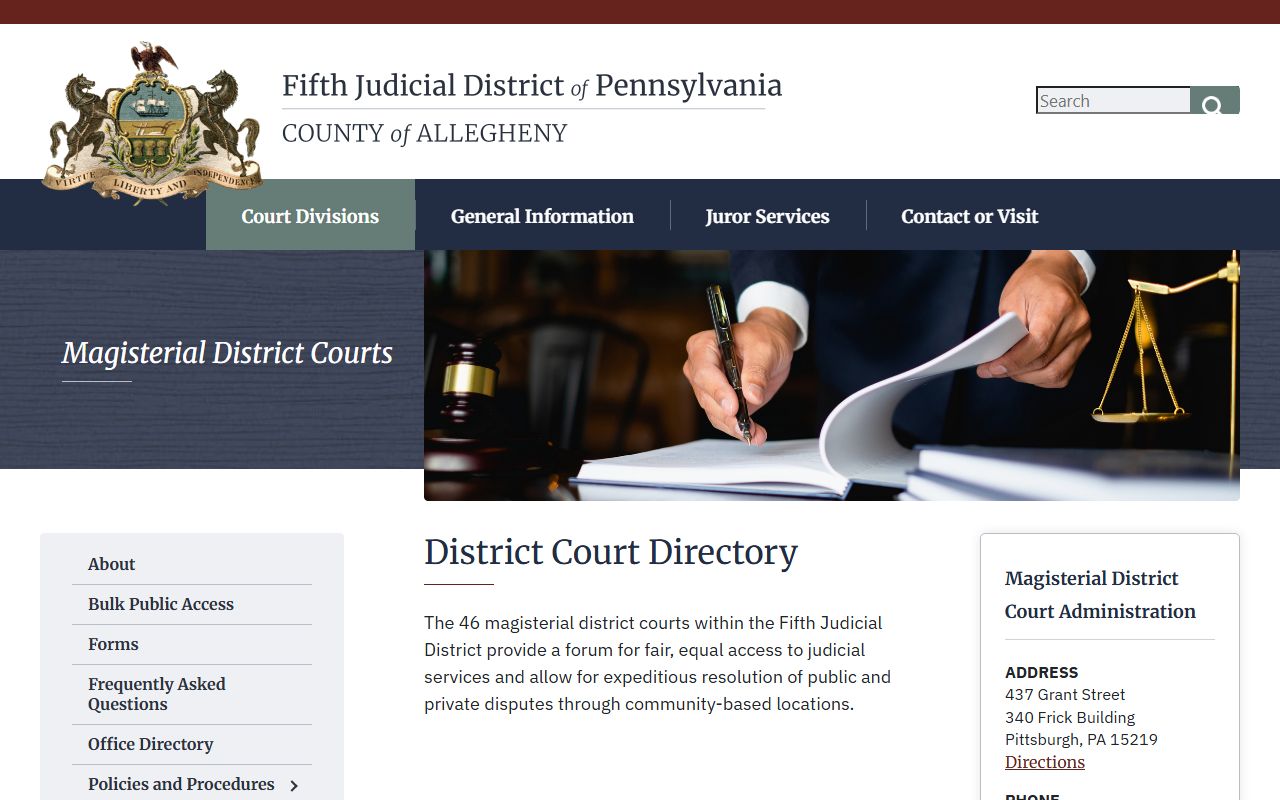
You can browse the magisterial district court directory to find the office that serves a town or Pittsburgh ward. The records below are the ones people request most.
- Criminal dockets with charges, bail, pleas, and sentences.
- Civil filings, judgments, and arbitration awards up to the $50,000 ceiling.
- Family cases, including divorce, custody, and support, with limited remote access.
- Magisterial district court records: summary traffic, civil claims up to $12,000, and landlord-tenant cases.
- Orphans' Court estate, will, and guardianship files.
What Allegheny County Court Records Show
A docket sheet is the public index of a case. It names the court and the docket number, lists the parties and lawyers, and logs each event in order. Criminal and summary dockets add the statute, grade, disposition, and any fines or costs. The actual filed documents, such as complaints and motions, sit in the case file, which you request from DCR. The table below shows the fields you will read on a typical docket.
| Field | What It Shows |
|---|---|
| Docket Number | The case ID; CP-02 marks Common Pleas Allegheny County, MJ-05 marks a magisterial district court. |
| Filing Date | When the complaint, petition, or citation was filed. |
| Parties | Plaintiff and defendant, Commonwealth and defendant, or petitioner and respondent. |
| Disposition | The result of each charge or claim, such as guilty, dismissed, or a judgment. |
| Docket Entries | The event log: complaint, motion, order, hearing, plea, sentence, and appeal entries. |
A few terms come up on almost every Allegheny County docket. Knowing them makes the record far easier to read.
- Plaintiff / Defendant
- The party who starts a civil case, and the party sued or charged.
- Commonwealth
- The prosecuting party in a Pennsylvania criminal case.
- OTN
- Offense Tracking Number, the state ID that links one person's charges across the system.
- Disposition
- The outcome of a charge or claim, such as guilty, dismissed, or a judgment.
- Bench Warrant
- An arrest order from a judge, often after a missed court date.
Public Access Framework for Allegheny County Court Records
Court case access in Pennsylvania follows the judiciary's own policy, not the general Right-to-Know Law. The central rule is the Case Records Public Access Policy at 204 Pa. Code § 213.81. It says case records are open to the public, then defines confidential information and limits remote access for some case types. General agency records still follow the Right-to-Know Law, but a court file is requested from DCR.
Anyone can view a public case file unless a judge sealed it. You do not need a reason. Copies carry a fee, and certified copies cost more than plain ones. Sensitive identifiers are redacted under the access policy, so a public docket will not show a full Social Security number or financial account data.
A court docket and a criminal history check are not the same product. The Criminal History Record Information Act, 18 Pa.C.S. Ch. 91, governs how criminal history is shared, sealed, or expunged through the state police repository. A public UJS docket shows one case at a time, while a full criminal history background check is a separate, regulated record. People doing employment or tenant screening should use the proper channel, not a single docket.
Note: Public dockets are open, but full family and estate case files have remote-access limits, so some documents need an in-person or DCR request.
Records That Are Sealed or Confidential in Allegheny County
Some records are not open. Juvenile court files are restricted to listed people and agencies. Adoption records are confidential and run through Orphans' Court. Mental health commitment records are sensitive. Victim, witness, and juror details in criminal cases are shielded, and so are sealed records and grand jury materials. Confidential filings, such as Social Security numbers and a minor's birth date, must go on confidential forms.
To view a sealed record, a person normally petitions the court that ordered the seal and shows legal grounds. Summary traffic and other summary convictions can be appealed, and the county handles those appeals through its Criminal Division.
The summary appeals page explains the 30-day deadline and the $94 fee. For DUI and other charges that route to criminal court, see Allegheny County arrest records.
In-Person Court Record Requests and Fees
For copies of a case file, visit or call the DCR division that holds it. Civil and family files are at the City-County Building. Criminal files are at the courthouse. Bring the docket number, a photo ID, and a way to pay. Plain copies and certified copies carry separate fees, and each division posts its own schedule.
Court Records – Civil/Family Division
City-County Building, 414 Grant Street, 1st Floor
Pittsburgh, PA 15219
412-350-5729
Mon–Fri 8:30 a.m.–4:30 p.m.
The county posts a civil and family fee schedule online, so you can confirm copy and certification costs before you go.
That civil and family fee schedule covers the Civil/Family side. The Criminal Division posts its own cost list separately.
The criminal records cost and fee schedule lists criminal copy fees. A DCR records retention fee also applies per filing, rising from $3.50 to $7.00 on June 1, 2026.
Keep one distinction in mind. The UJS docket is the index, while the case file is the stack of filed papers behind it. UJS usually shows docket detail, not full document PDFs, so a complaint, motion, or order copy comes from DCR. Estate, will, and marriage record copies go through the Wills/Orphans' Court Division rather than Civil/Family or Criminal, so pick the division that matches the case type before you call.