
What Probate Covers in Allegheny County
Probate is the court process that settles what a person leaves behind. In Allegheny County, that work runs through Orphans' Court and the Department of Court Records Wills/Orphans' Court Division. Together they handle decedent estates, trusts, and wills. They also handle guardians of the person and estate for minors and for incapacitated adults, powers of attorney, and inheritance and estate tax matters. The reach is wider than many expect. Orphans' Court also takes adoptions and termination of parental rights, civil commitments, marriage licenses, and nonprofit associations.
Two offices share the load. The Orphans' Court Division of the Court of Common Pleas is the judicial side, where judges and auditing judges hear estate, guardianship, and adoption matters. The DCR Wills/Orphans' Court Division is the records and filing side, where you open an estate, file forms, and request copies. Adoption matters, including termination of parental rights and biological-parent searches, are processed by the Orphans' Court Adoption Department, except for Children, Youth and Families dependency matters that run through Juvenile Court.
Civil commitments are part of this division too. After an emergency commitment under the Mental Health Procedures Act, 50 P.S. § 7101 et seq., Orphans' Court schedules hearings, often held at the hospital or facility, before Mental Health Review Officers. The Law Department represents petitioners and the Public Defender represents respondents.
Probate Terms Defined
Estate files use words that trip people up. A short glossary makes a probate record far easier to read before you open one.
- Testator
- The person who made the will.
- Executor
- The person named in a will to carry it out and settle the estate.
- Intestate
- Dying without a valid will, so state law decides who inherits.
- Letters Testamentary
- The court paper that gives an executor legal power to act for the estate.
- Letters of Administration
- The court paper that names an administrator when there is no will or no named executor.
- Guardian
- A person the court names to care for a minor or an incapacitated adult, or to manage that person's estate.
- Conservator
- A person appointed to manage another's property or finances; in Pennsylvania this role often falls under guardianship of the estate.
How to Search Allegheny County Orphans' Court Records
Probate and Orphans' Court records are searched and requested through the DCR e-Filing and Retrieval System for Wills and Orphans' Court. The portal also links probate forms, fee schedules, and a Will Search Request Form. Some account types, such as ACH and draw-down users, have their own logons. Remote access is limited for many fiduciary records, so the public side often shows dockets, orders, and opinions rather than full files.
- Open the county Wills/Orphans' Court resources page and choose the e-Filing and Retrieval System.
- Register or log in if your search or filing needs an account.
- Search by the decedent's name or estate details, or submit a Will Search Request Form for an older record.
- Request copies through DCR Wills/Orphans, and expect remote access to be limited to dockets, orders, and opinions for many records.
The county collects these tools on one Wills and Orphans' Court resources page, which is the best entry point for estate research.
You can open the Allegheny County probate records and Wills/Orphans resources page to reach the e-filing system, the forms library, and the fee schedules. It also links the estate refund policy and living will resources.
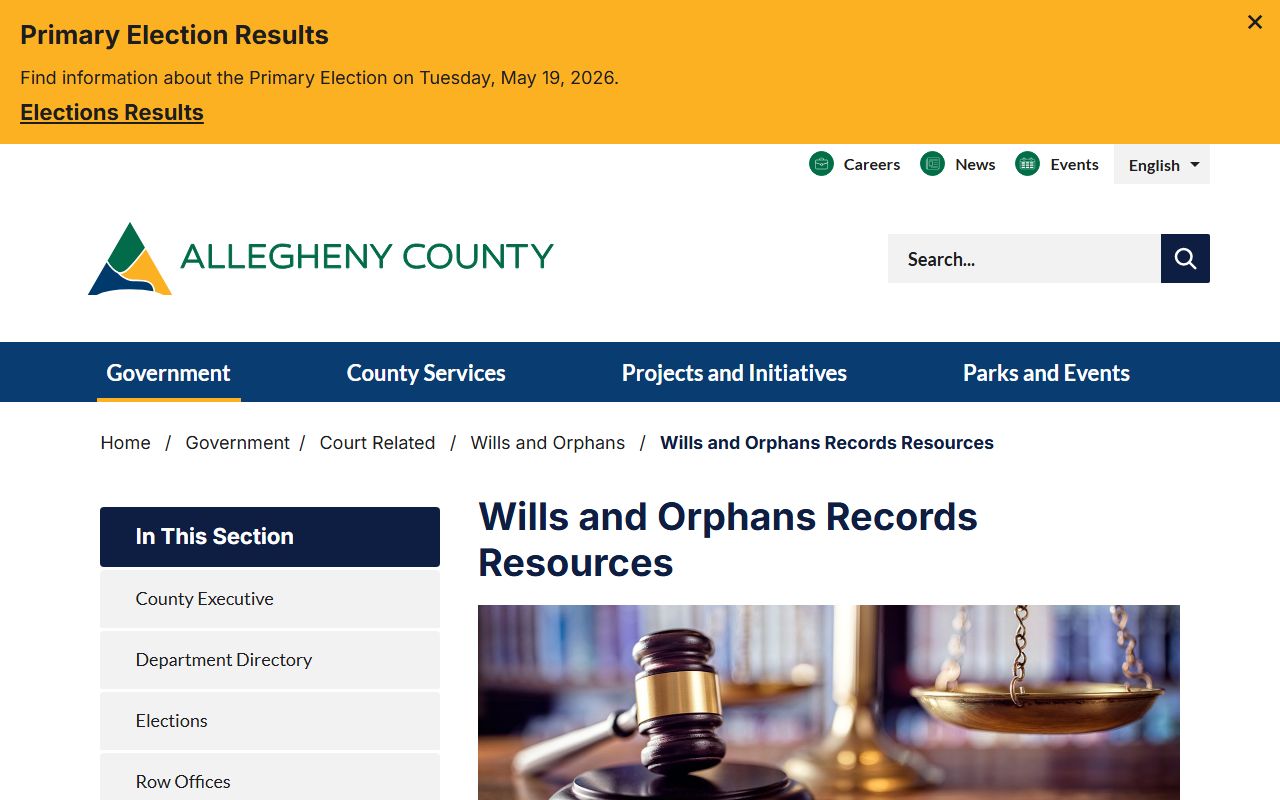
That page groups the filing system, forms, and fee schedules together. Start there before you visit the courthouse for an estate matter.
Orphans' Court in Allegheny County
The judicial side of probate is the Orphans' Court Division. Its offices sit in the Frick Building on Grant Street, a short walk from the main courthouse and the City-County Building. Judges and auditing judges there hear estate audits, guardianship petitions, adoptions, and commitment matters. For forms questions, the county lists separate phone lines.
Orphans' Court Division
1700 Frick Building, 437 Grant Street
Pittsburgh, PA 15219
412-350-5550
Fax 412-350-1925
Mon–Fri 8:30 a.m.–4:30 p.m.
Forms: 412-350-5563 / 412-350-6146
The division runs through several departments. Each one handles a different slice of probate work.
- Adoptions: domestic and foreign adoptions, agency and non-agency cases, and re-adoptions where immigration rules require them.
- Audits, Estates and Trusts: examines accounts and petitions for distribution, prepares distribution decrees, and reviews small-estate petitions.
- Civil Commitments: schedules hearings after emergency mental health commitments and assigns Mental Health Review Officers.
- Guardianship: processes guardian appointments for minors and incapacitated adults and reviews annual and final guardian reports.
How Probate Works in Allegheny County
Settling an estate follows a path. The order below tracks the county's own outline of how a probate matter moves from death to distribution. Most steps run through the DCR Wills/Orphans function and, when contested, before Orphans' Court judges.
- Confirm the decedent lived in Allegheny County and find out whether there is a will.
- Use the Wills/Orphans' Court Division resources and the current probate forms.
- Open the estate through the Register of Wills and DCR Wills/Orphans function.
- Get letters testamentary, or letters of administration if there is no will, once you are appointed.
- Give required notices, collect assets, address debts and taxes, and file the inventory and accounting.
- Take contested accounts, distribution, guardianship, or adoption matters before Orphans' Court judges.
- Request copies through DCR Wills/Orphans, where remote access may be limited to dockets, orders, and opinions.
Note: An estate is opened where the decedent was domiciled, so confirm Allegheny County residency before you file probate forms with the county.
Probate Portal and Forms
The Wills/Orphans portal is built around a set of actions and form links rather than a single search box. You register or log on, then reach the fee schedules, form libraries, and the Will Search Request Form. The table lists the main actions and links captured from the county Wills/Orphans resources.
| Field / Action | Type | Required | Notes / Format |
|---|---|---|---|
| Register | Link / action | Optional | Creates a Wills/Orphans account. |
| User Logon | Link / action | Conditional | Needed for retrieval or filing. |
| ACH Account Users Logon | Link / action | Conditional | For ACH payment account users. |
| Draw Down Account Users Logon | Link / action | Conditional | For draw-down account users. |
| Probate Fee Schedule | Link / PDF | Optional | Published fee schedule. |
| Probate Forms | Link | Optional | Probate form library. |
| Orphans' Court Forms | Link | Optional | County and statewide UJS forms. |
| Will Search Request Form | PDF link | Optional | Used to request a will search. |
Filing fees for probate and Orphans' Court matters are set in the county's published Probate Fee Schedules and Orphans' Court Fee Schedules, linked from that same resources page. Because amounts change and vary by action, check the current posted schedules rather than relying on a memorized figure. A DCR records retention fee also applies to new filings, rising from $3.50 to $7.00 effective June 1, 2026.
What Allegheny County Probate Records Show
A probate file builds a record of the whole estate. It can include the will, the petition that opened the estate, the letters that name the executor or administrator, and the inventory of assets. Later filings add the accounting, the distribution petition, and the decree of distribution entered after an audit hearing. Guardianship files add the petition, the appointment, and the annual or final reports the guardian must file. Trust, power of attorney, and small-estate matters generate their own filings.
The public docket lists these events and the orders entered, even when the full documents are not online. For many fiduciary records, remote access is held to dockets, orders, and opinions. So the docket tells you what happened and when, while the underlying papers are pulled through DCR Wills/Orphans. For broader case research across divisions, see Allegheny County court records.
Restricted Orphans' Court Records
Some Orphans' Court records are not open to general browsing. Adoption records are confidential and follow special access procedures under 23 Pa.C.S. Chapter 29. Mental health commitment records tied to the Mental Health Procedures Act are sensitive, and a request form exists rather than open public access. Records sealed or protected by court order are excluded from public view.
Remote access is the other big limit. Under the judiciary's case-records public access policy, access to probate, estate, and fiduciary case records governed by the Probate, Estates and Fiduciaries Code and related protective statutes is limited to dockets, orders, and opinions unless otherwise allowed. The full policy text is the controlling rule.
You can read the access policy at 204 Pa. Code § 213.81, which sets out what is open and what is held back for fiduciary records. The county follows that policy when it answers a copy request.
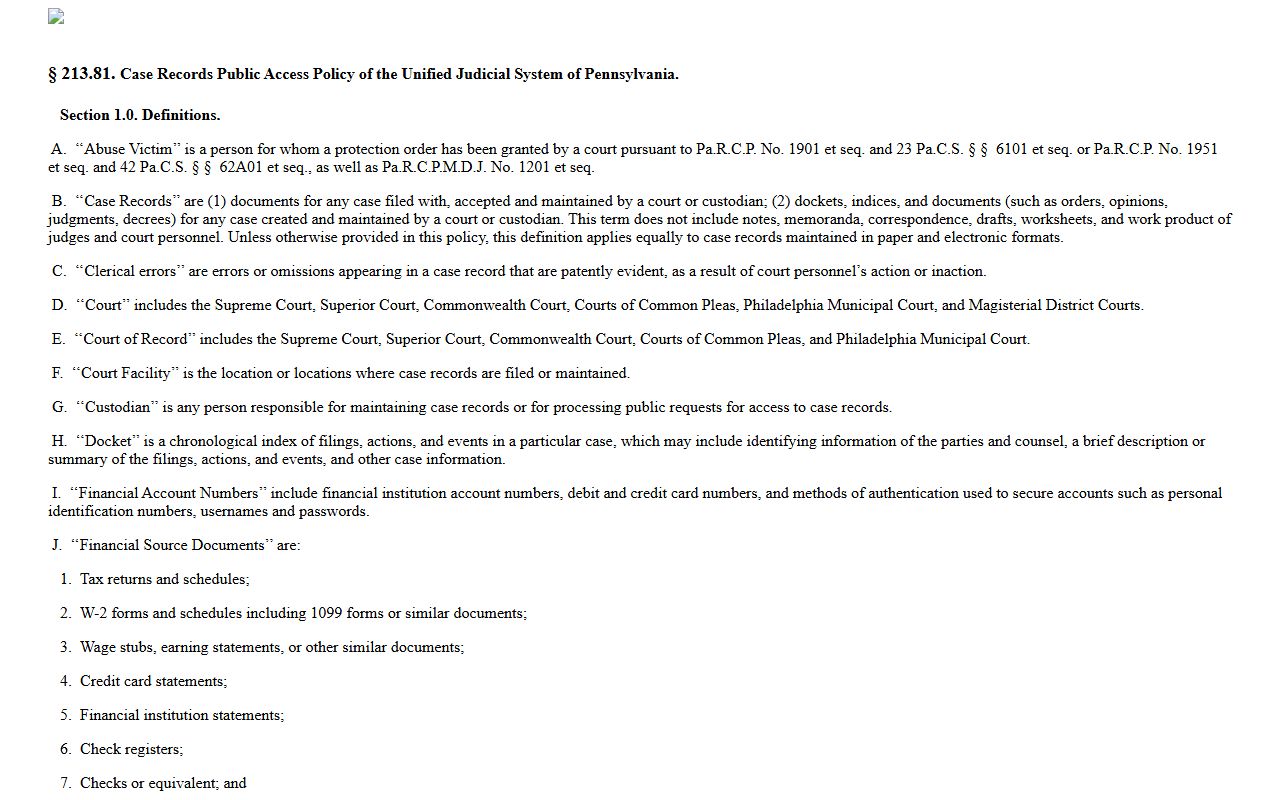
That section is why so much of a probate file stays at the docket level online. The full chapter sits in the Pennsylvania Code alongside the rest of the access rules.
The broader chapter that holds § 213.81 covers electronic case records access across Pennsylvania courts.
You can browse the full Chapter 213 electronic case record access rules for the table of contents and related sections. It frames how Orphans' Court records fit the statewide policy.
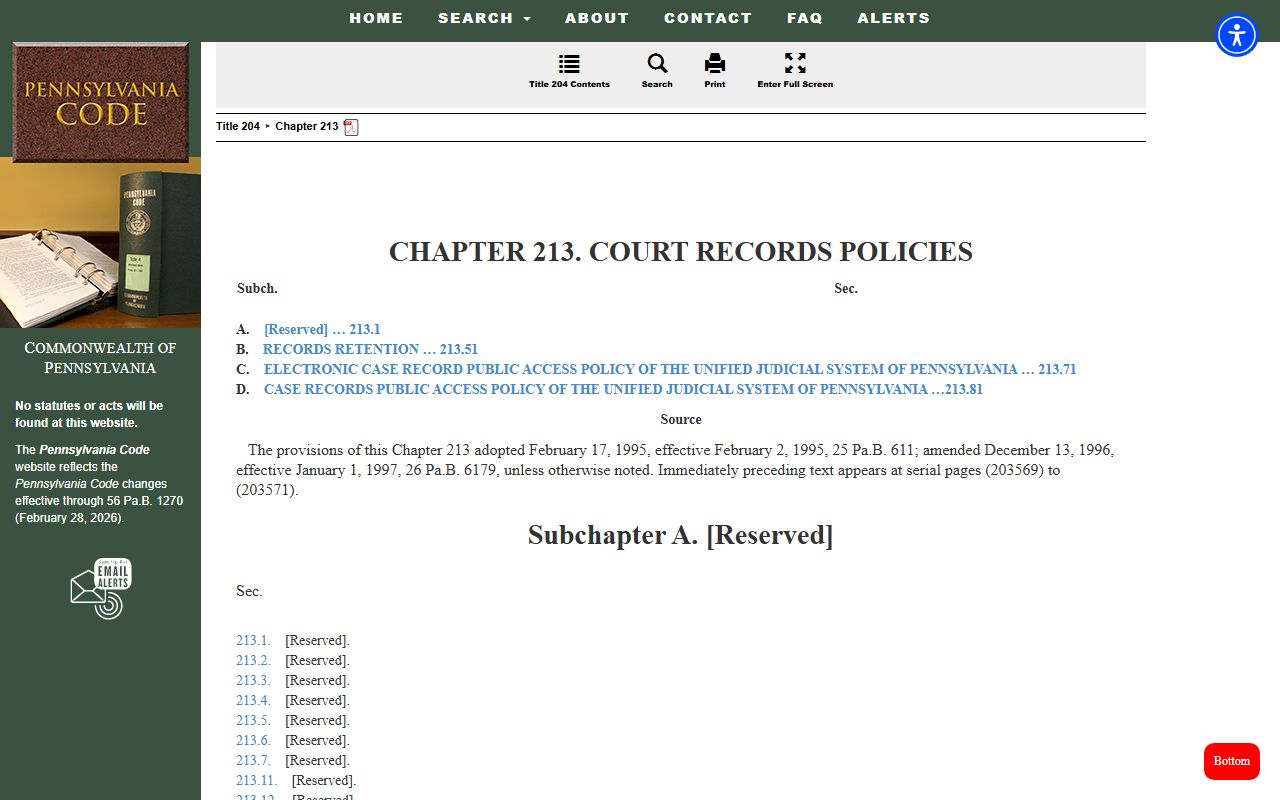
That chapter index helps when you need the exact rule behind a denied or limited record. It ties the county's practice back to state law.