
Allegheny County Court of Common Pleas Overview
The Court of Common Pleas is Pennsylvania's trial court of general jurisdiction. In Allegheny County it handles the bulk of serious cases. That means criminal prosecutions, civil suits over money or property, family matters like custody and support, and estate work in Orphans' Court. The court runs four divisions, each led by an administrative judge appointed by the Supreme Court of Pennsylvania. In all, the court has 43 commissioned judges, plus senior judges who help across the divisions.
Allegheny County is the Fifth Judicial District of Pennsylvania. The court is based in the Allegheny County Courthouse at 436 Grant Street in Pittsburgh, with related offices spread across a downtown courthouse complex on Grant, Ross, and First Avenue. The president judge has supervisory authority over the county's magisterial district court system. You can read more about the divisions on the county court system pages.
It helps to view the courthouse location before a trip downtown, since "court" can mean different doors depending on the case.
You can view the courthouse location on the map for 436 Grant Street.

The map points to the main courthouse, but criminal filings, civil filings, and Orphans' Court hearings each sit in their own building. The next section lists the four divisions with addresses and phone numbers.
Courts of the Fifth Judicial District
The Court of Common Pleas is split into four divisions, and the lower courts handle the front end of the system. Criminal cases sit at the courthouse on Grant Street. Civil and family work runs through the City-County Building. Orphans' Court, which covers wills and estates, sits in the Frick Building. The table below lists each division and lower court with its address, phone, and what it handles.
| Court / Division | Address | Phone | Jurisdiction |
|---|---|---|---|
| Common Pleas – Criminal Division | 436 Grant Street, Room 534 Courthouse, Pittsburgh, PA 15219 | 412-350-5500 | Criminal prosecutions, Adult Probation, Pretrial Services, ARD, bail, summary appeals. |
| Common Pleas – Civil Division | City-County Building, 7th/8th Floors, 414 Grant Street, Pittsburgh, PA 15219 | 412-350-0591 | General civil, arbitration up to $50,000, Board of Viewers, housing court, civil motions. |
| Common Pleas – Family Division | 440 Ross Street, Pittsburgh, PA 15219 | See judge directory | Custody, support, dependency, juvenile and family matters. |
| Common Pleas – Orphans' Court | 1700 Frick Building, 437 Grant Street, Pittsburgh, PA 15219 | 412-350-5550 | Estates, trusts, wills, guardianships, adoptions, civil commitments. |
| Magisterial District Court Administration | 437 Grant Street, 340 Frick Building, Pittsburgh, PA 15219 | 412-350-5485 | Administrative office for the 46 Magisterial District Courts. |
| Pittsburgh Municipal Court | 660 First Avenue, Pittsburgh, PA 15219 | 412-350-6715 | Pittsburgh traffic, non-traffic, ordinance, and preliminary criminal cases. |
The Pennsylvania judiciary publishes its own hierarchy chart that shows where Common Pleas sits in the state system.
That chart is on the Pennsylvania courts page, which maps minor courts up through the Supreme Court.
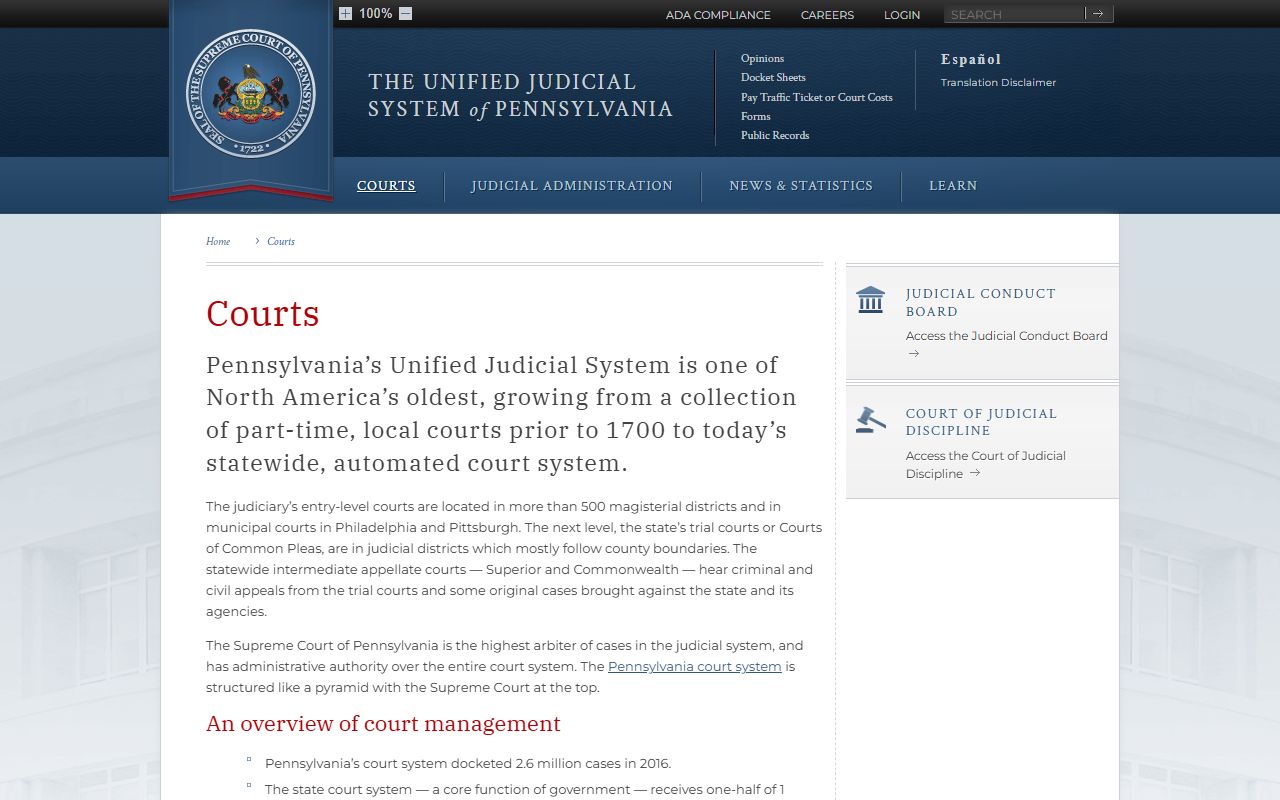
The chart confirms the trial-court role of Common Pleas and the appeal path above it, which the case-flow section covers in detail.
Court of Common Pleas vs Pittsburgh Municipal Court vs Magisterial District Court
Allegheny County uses three trial-level court types, and each has a clear lane. The Court of Common Pleas hears the most serious cases and acts as the appeal court for the minor judiciary. Pittsburgh Municipal Court covers the city's traffic, ordinance, and preliminary criminal work. The 46 Magisterial District Courts serve towns and Pittsburgh wards with small claims, summary cases, and the first steps of criminal matters. The table sets them side by side.
| Court of Common Pleas | Pittsburgh Municipal Court | Magisterial District Court | |
|---|---|---|---|
| Civil Limit | No fixed ceiling; arbitration cases up to $50,000 | Limited city civil and ordinance matters | Civil claims up to $12,000 |
| Criminal Role | Felony and misdemeanor trials, sentencing, summary appeals | Preliminary criminal, plus homicide preliminaries countywide | Summary offenses and preliminary hearings |
| Family Cases | Yes, in the Family Division | No | No |
| Area Served | All of Allegheny County | City of Pittsburgh | One district within the county |
A case can move up the chain. A summary conviction at a district court can be appealed to the Criminal Division. A felony charge usually starts with a preliminary hearing in a minor court, then moves to Common Pleas for trial. The lane a case sits in tells you which docket to search first.
How a Case Moves Through the Allegheny County System
Most cases follow a set path. A criminal case often starts with an arrest and a preliminary arraignment, moves through a preliminary hearing in a minor court, then heads to the Criminal Division for trial and sentencing. A civil case starts with a filed complaint, runs through pleadings and discovery, and can reach arbitration or trial in the Civil Division. Appeals leave Common Pleas for a statewide appellate court.
Criminal flow: Arrest › Preliminary Arraignment › Preliminary Hearing (minor court) › Formal Arraignment › Pretrial › Trial (Common Pleas) › Sentencing › Appeal
Civil flow: Complaint Filed › Answer › Discovery › Arbitration or Pretrial › Trial › Judgment › Appeal
The appeal path runs above Common Pleas. Most civil and criminal appeals go to the Superior Court of Pennsylvania. Cases that involve state or local government usually go to the Commonwealth Court. The Supreme Court of Pennsylvania is the court of last resort and oversees the whole system. The Pennsylvania judiciary posts public record policies that explain how case records flow through these levels.
Those rules sit on the Pennsylvania judiciary public record policies page, which sets the statewide access framework.
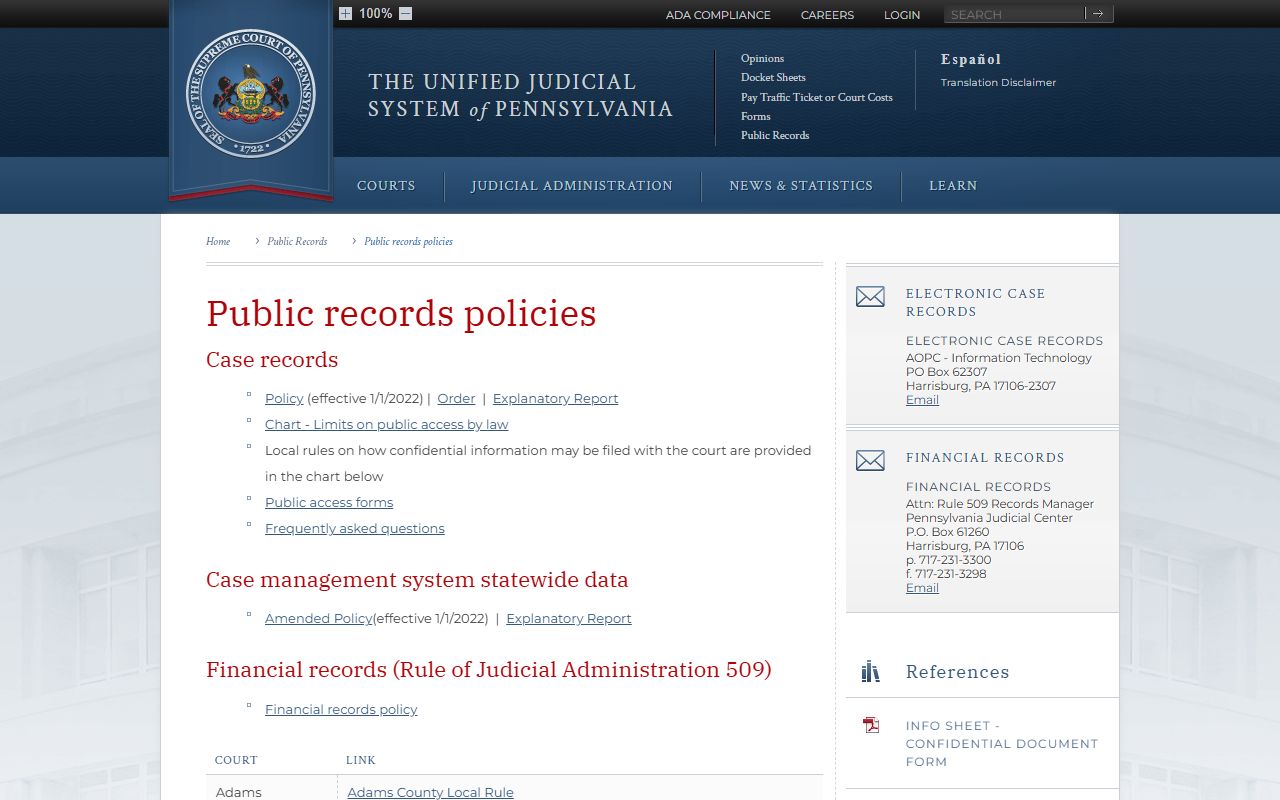
The policy page matters because it controls what shows up in a public docket and what stays sealed. Family and juvenile matters carry the tightest limits.
Civil, Family, Criminal, and Orphans' Court Divisions
Each division has its own focus, staff, and home building. The Criminal Division handles prosecutions and runs Adult Probation, Pretrial Services, the ARD diversion track, bail services, and summary appeals. It sits in Room 534 of the courthouse at 436 Grant Street. The Civil Division hears suits over money and property, plus arbitration, the Board of Viewers, and housing court, from the 7th and 8th floors of the City-County Building.
The Family Division covers custody, support, dependency, and juvenile cases, with offices in the Ross Street area. The Orphans' Court Division handles estates, trusts, wills, guardianships, adoptions, and civil commitments from the 1700 Frick Building. Adoption and termination-of-parental-rights matters run through the Orphans' Court Adoption Department, except for cases tied to Children, Youth and Families that go through Juvenile Court.
Juvenile records carry strict access limits. State law controls who may inspect a juvenile file.
The rule on juvenile file inspection sits at 42 Pa.C.S. § 6307, which lists the people and agencies allowed to view those records.
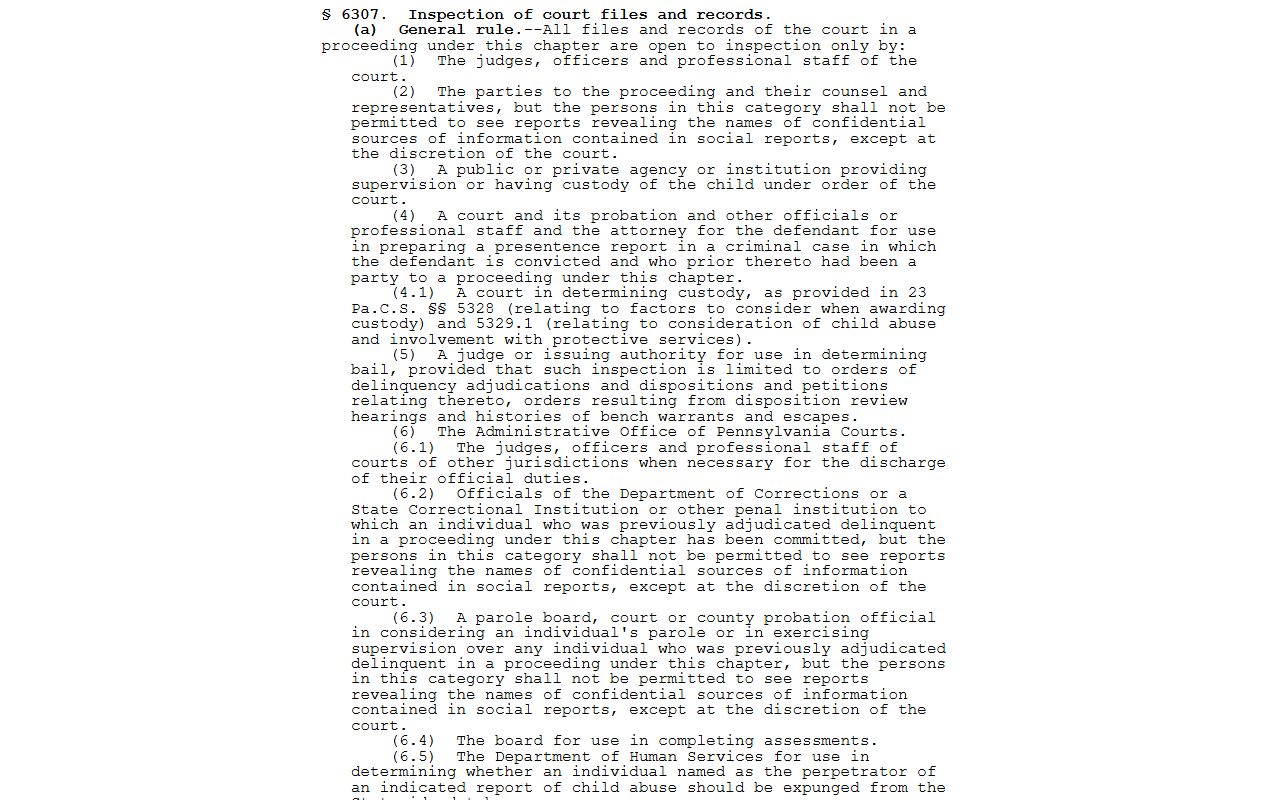
Because of that statute, juvenile dockets do not appear in the open public search the way adult criminal dockets do. Most public lookups will hit the Criminal, Civil, and Orphans' divisions.
The Fifth Judicial District
Allegheny County and the Fifth Judicial District are the same footprint. The district covers the whole county. The Court of Common Pleas runs the trial work, while the president judge oversees court administration and the minor judiciary. Senior judges fill in across divisions as caseloads shift.
The district is one of the largest in Pennsylvania by case volume. Its 43 commissioned judges spread across the four divisions, and a public directory lists each judge with a division, room, and phone. Court administration also runs the office that supervises the 46 Magisterial District Courts. The county's historic courthouse complex, designed by H. H. Richardson in the 1880s, still houses much of this work today.
Note: A case caption that names the Court of Common Pleas of Allegheny County is a Fifth Judicial District case and is searched through the statewide docket tool.
Magisterial District Courts and Pittsburgh Municipal Court
The minor judiciary is where many cases begin. The 46 Magisterial District Courts give towns and Pittsburgh wards local access for summary traffic and non-traffic cases, landlord-tenant disputes, and civil claims up to $12,000. Each district has its own judge, office, and phone. The administrative office for all of them sits at 437 Grant Street in the 340 Frick Building. The table below shows a sample of districts pulled from the official directory.
| Area | District | Judge | Address | Phone |
|---|---|---|---|---|
| Avalon / Bellevue / Ben Avon | 05-2-01 | Tara L. Smith | 660 Lincoln Avenue, 2nd Floor, Pittsburgh, PA 15202 | 412-761-8770 |
| Baldwin Borough | 05-2-18 | Candace Stockey Seymour | 5001 Curry Road, Unit 2, Pittsburgh, PA 15236 | 412-714-8354 |
| Bethel Park | 05-2-20 | Ronald A. Arnoni | 2414 Lytle Road, Suite 200, Bethel Park, PA 15102 | 412-835-1661 |
| Homestead | 05-2-15 | Patrick Campbell | 510 East Eighth Avenue, Munhall, PA 15120 | 412-461-5977 |
| Plum | 05-2-32 | Michael J. Doyle | 10101 Saltsburg Road, Plum, PA 15239 | 412-793-2727 |
| Wilkinsburg | 05-2-10 | Iren B. Evans | 907 West Street, Suite 101, Wilkinsburg, PA 15221 | 412-241-6529 |
Pittsburgh Municipal Court is the city's version of the minor judiciary. It handles Pittsburgh traffic, non-traffic, ordinance, and preliminary criminal matters at 660 First Avenue. It also holds preliminary hearings for homicide cases that occur anywhere in the county. Emergency Protection From Abuse petitions and Arraignment Court run there 24 hours a day. Summary convictions from these courts can be appealed to the Criminal Division within 30 calendar days.
Note: A summary appeal must be filed within 30 days of the conviction, and the county handles those filings through the Criminal Division.
The Allegheny County Courthouse
The main courthouse at 436 Grant Street is the heart of the court system. It was designed by Henry Hobson Richardson and built in the 1880s, and it became a leading example of Richardsonian Romanesque architecture. The county runs the building as a working civic and event space as well as a court.
The official county venue page describes the courthouse complex, the Grand Staircase, the courtyard, and the County Office Building lobby.
You can read about the building on the Allegheny County Courthouse venue page.
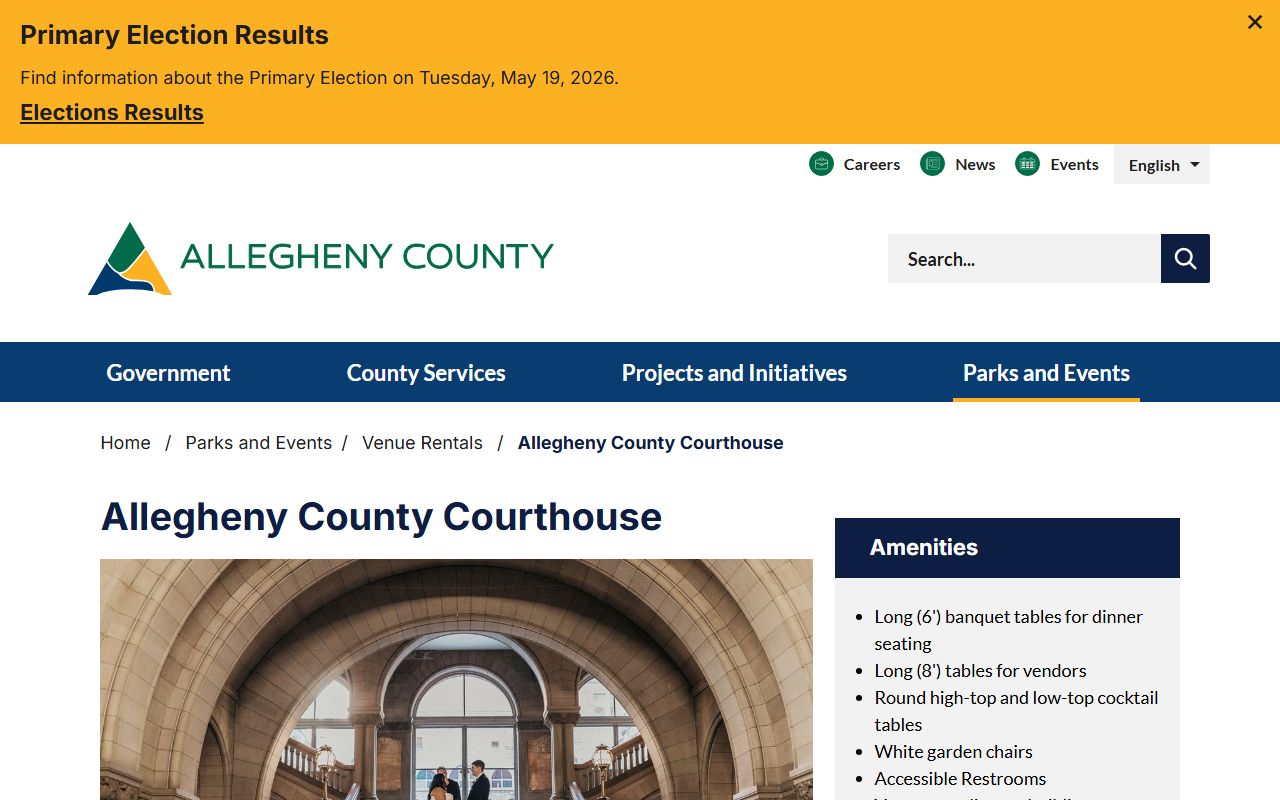
The complex also holds the former Courthouse Jail Annex, now used for Family Court, which is a National Historic Landmark. For records and filings, though, the practical point is the door, not the architecture.