
How to Search Allegheny County Court Records
Most Allegheny County court records start with one tool. The Pennsylvania Unified Judicial System case search holds public dockets for the Court of Common Pleas, the magisterial district courts, Pittsburgh Municipal Court, and traffic and citation cases. You can search by a person's name, a docket number, a citation number, or an Offense Tracking Number, which courts call an OTN. The statewide search is free, and you do not need an account to look up most dockets.
Before you start, gather what you know. A full legal name helps, and a date of birth or a filing date cuts down on false matches. If you have the docket or citation number, use it, because that returns one case fast.
The county also runs its own portal for filing and copies. The Department of Court Records, known as DCR, handles civil, family, criminal, and wills and estate filings through its e-filing and retrieval system.
You can open the statewide docket tool at the Pennsylvania UJS case search, which is the front door for most public case lookups.
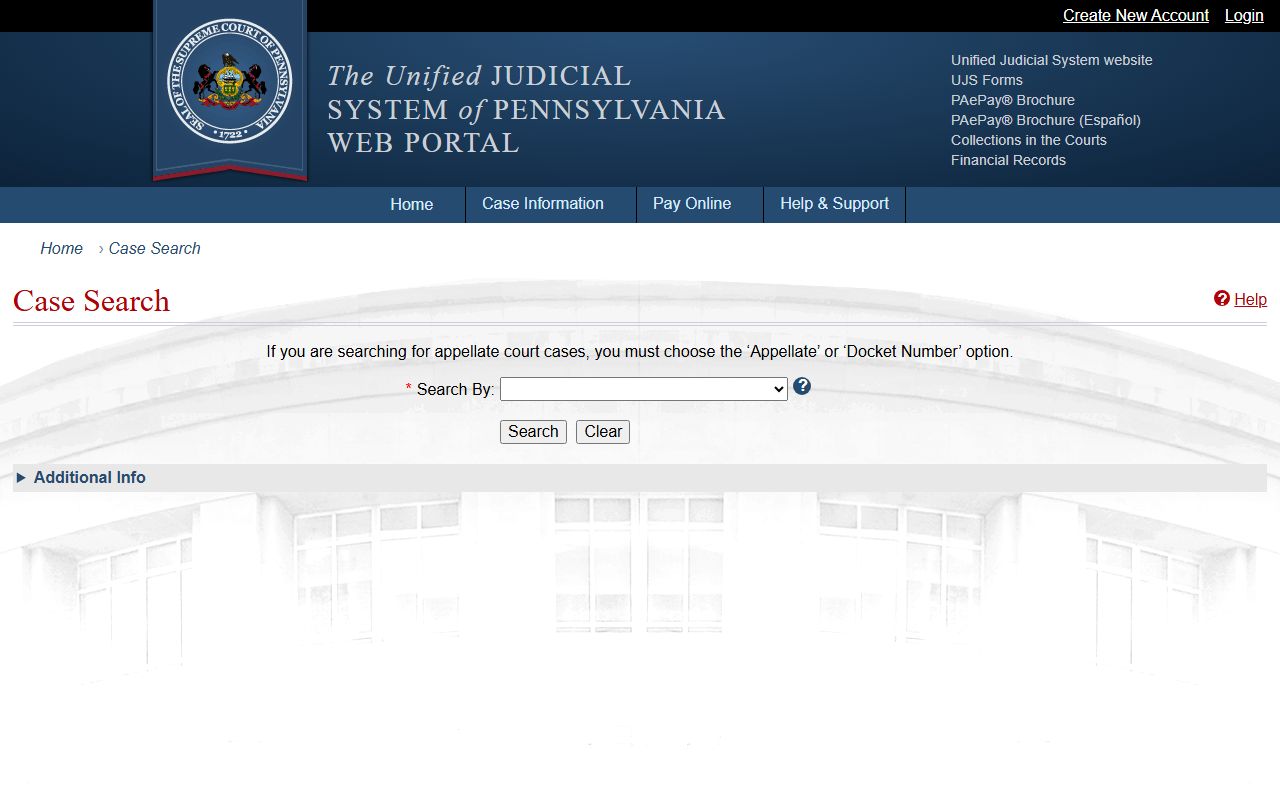
The portal lets you pick a search type and then set the county to Allegheny so results stay local. Once a case loads, the docket shows parties, charges or claims, events, and the case status.
- Open the Pennsylvania UJS case search and pick a search type, such as Participant Name or Docket Number.
- Set the county to Allegheny to drop matches from other counties.
- Enter the name or number, and add a filing date if the name is common.
- Submit the search and review the court, docket number, parties, and status.
- Open the docket sheet, then call or visit the right DCR division for certified copies.
For copies of filed documents rather than docket entries, the county DCR portal is the next stop. It splits work by division and routes you to the office that holds the file.
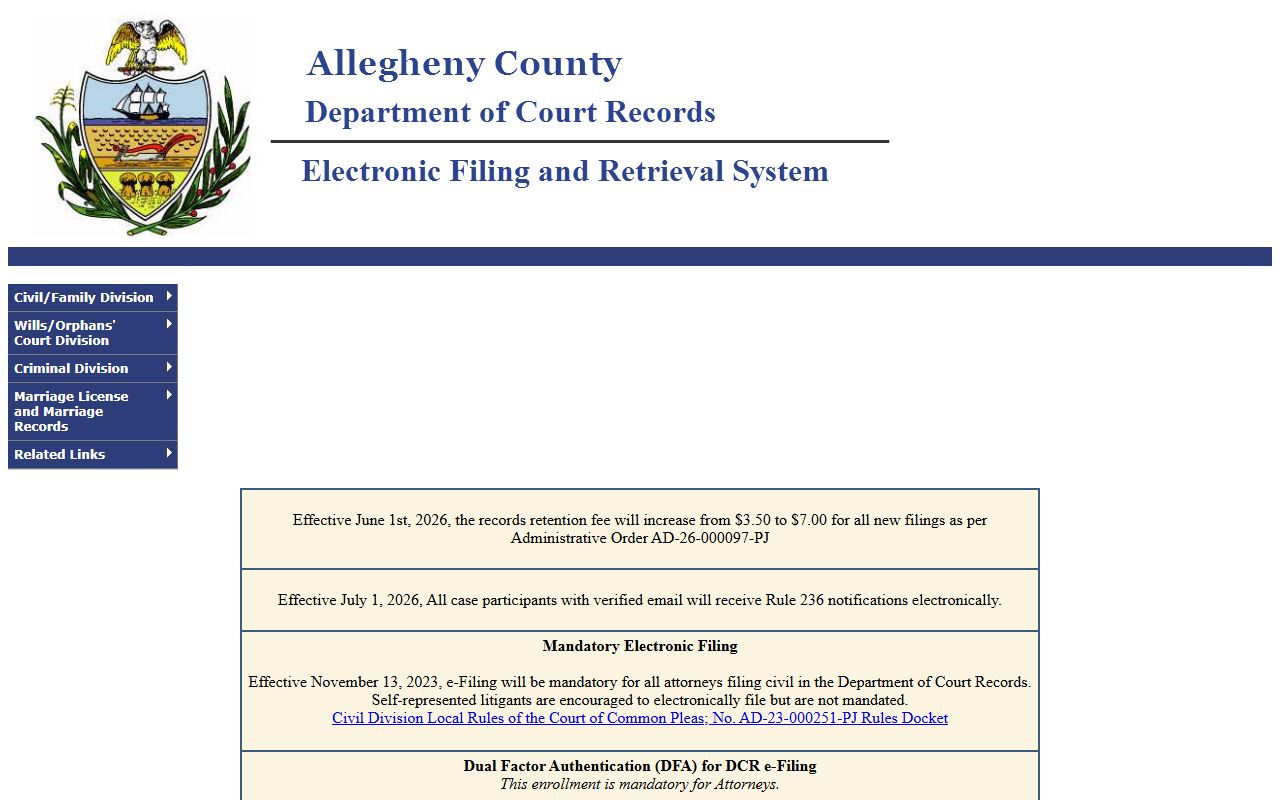
That portal at the Department of Court Records links the Civil/Family, Wills/Orphans, criminal, and marriage record paths in one place. Use it when the docket tool shows a case but you need the actual papers.
The Allegheny County Judicial System
Pennsylvania courts run in tiers. At the base are the minor courts: more than 500 magisterial districts statewide, plus municipal courts in Pittsburgh and Philadelphia. Above them sit the Courts of Common Pleas, the main trial courts. The Superior Court and the Commonwealth Court hear most appeals, and the Supreme Court of Pennsylvania is the last word. Allegheny County is the Fifth Judicial District, and its Court of Common Pleas has four divisions: Criminal, Civil, Family, and Orphans' Court.
The court division overview lists 43 commissioned judges plus senior judges, with an administrative judge over each division. Lower court work is large here too. The county has 46 magisterial district courts that handle summary traffic and non-traffic cases, landlord and tenant disputes, and civil claims up to $12,000. Pittsburgh Municipal Court covers city traffic, ordinance, and preliminary criminal matters, and it holds preliminary hearings in homicide cases from across the county.
You can read the county's own description of these divisions on the Fifth Judicial District court divisions overview, which lays out what each division decides.
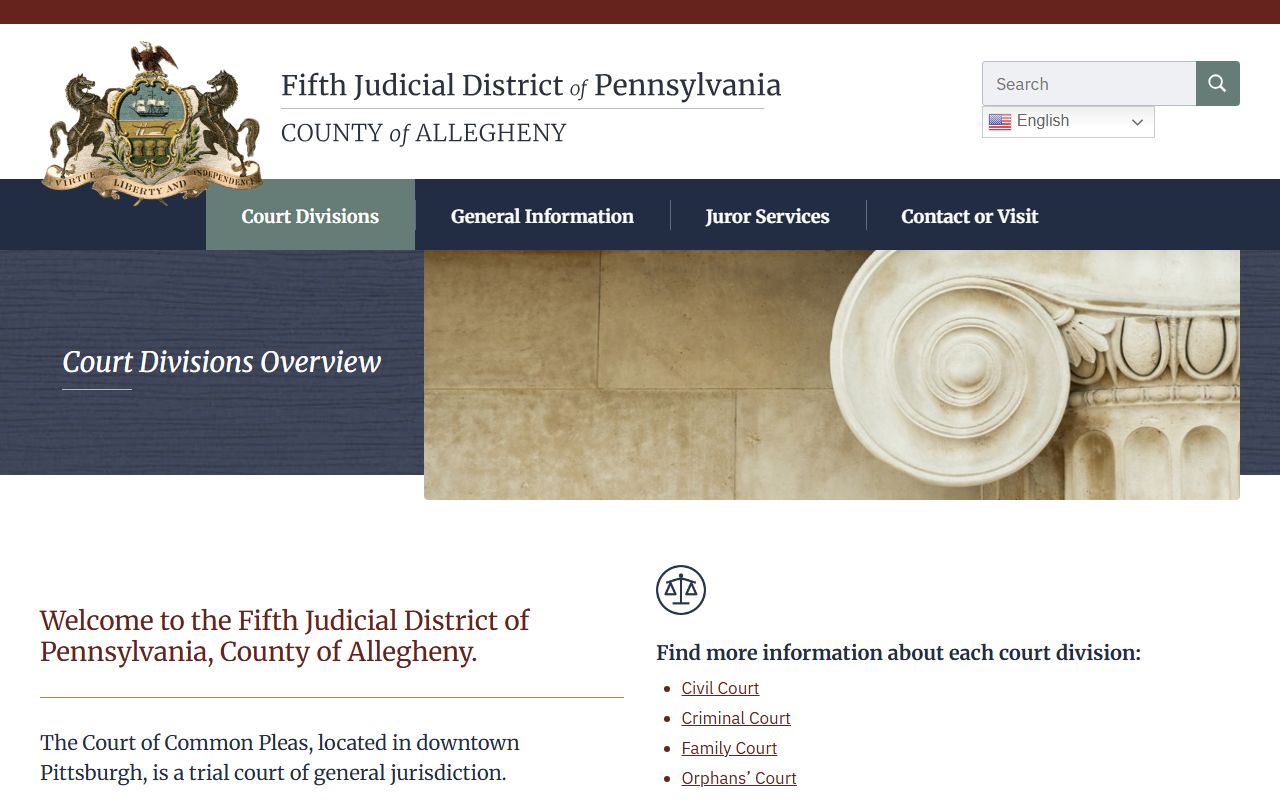
That page is a good first read because the division you need controls which office to call. Here is how a case moves up the system.
Case flow: Magisterial District Court › Court of Common Pleas › Superior Court or Commonwealth Court › Supreme Court of Pennsylvania
| Court | Jurisdiction | Case Types |
|---|---|---|
| Magisterial District Courts | Local, minor courts | Summary traffic, landlord/tenant, civil claims up to $12,000, preliminary hearings |
| Pittsburgh Municipal Court | City of Pittsburgh | City traffic, non-traffic, ordinance, preliminary criminal, countywide homicide preliminaries |
| Court of Common Pleas | Countywide trial court | Criminal, civil, family, Orphans' Court matters |
| Superior / Commonwealth Court | Statewide appeals | Most civil and criminal appeals; government and agency appeals |
Pittsburgh Municipal Court has a role no other county court shares. You can see its scope on the Pittsburgh Municipal Court page.
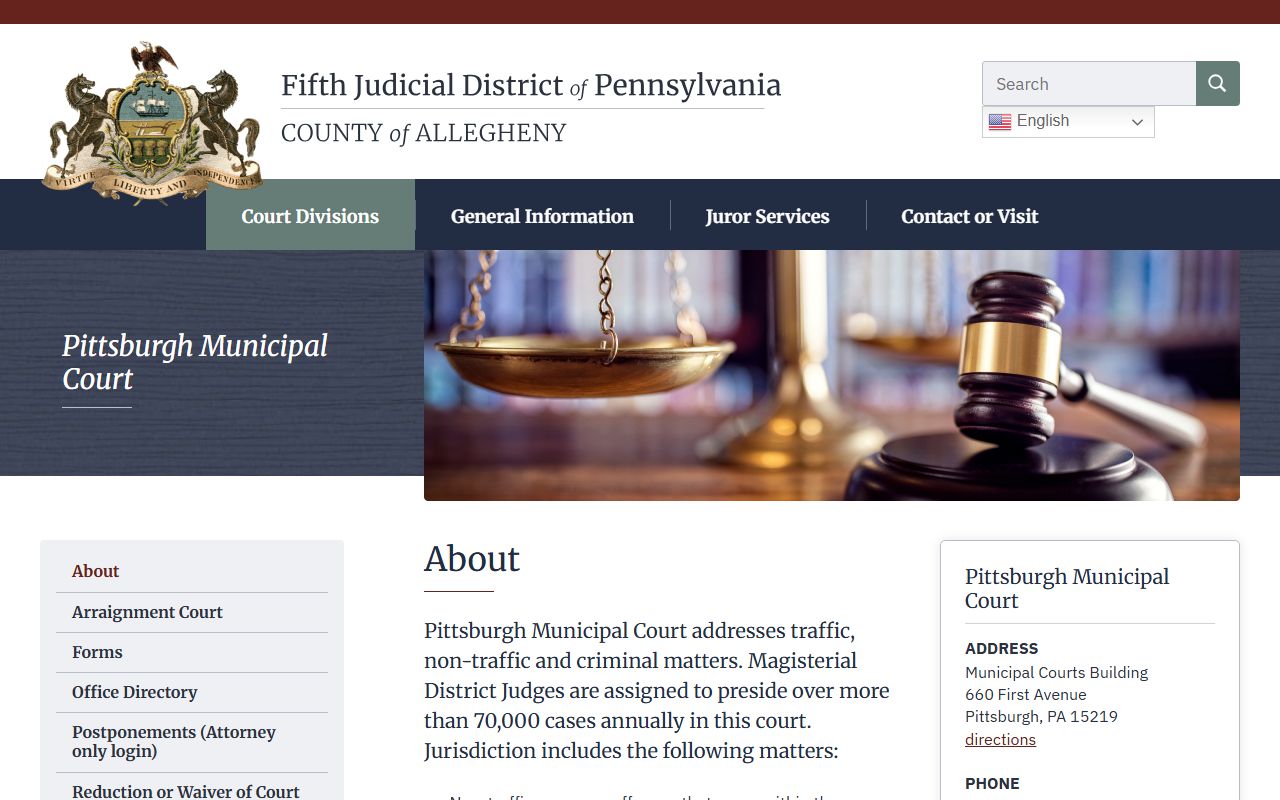
Note its 24-hour role for emergency protection orders and arraignment court. That detail matters for urgent family and criminal matters.
Allegheny County Courthouses
One warning helps new visitors: "the courthouse" can mean several buildings. Criminal court and criminal filings sit at the Allegheny County Courthouse on Grant Street. Civil and family filings go to the City-County Building. Orphans' Court hearings are generally in the Frick Building, and Pittsburgh's traffic and preliminary matters are on First Avenue. The buildings are close, but each door handles a different case type.
Allegheny County Courthouse (Criminal Division)
436 Grant Street, Room 534
Pittsburgh, PA 15219
412-350-5500
Court Records – Civil/Family Division
City-County Building, 414 Grant Street, 1st Floor
Pittsburgh, PA 15219
412-350-5729
Orphans' Court Division
1700 Frick Building, 437 Grant Street
Pittsburgh, PA 15219
412-350-5550
The whole complex grew from the 1880s courthouse on Grant Street. You can browse the courts' main site at the Fifth Judicial District homepage for division pages, contacts, and notices.
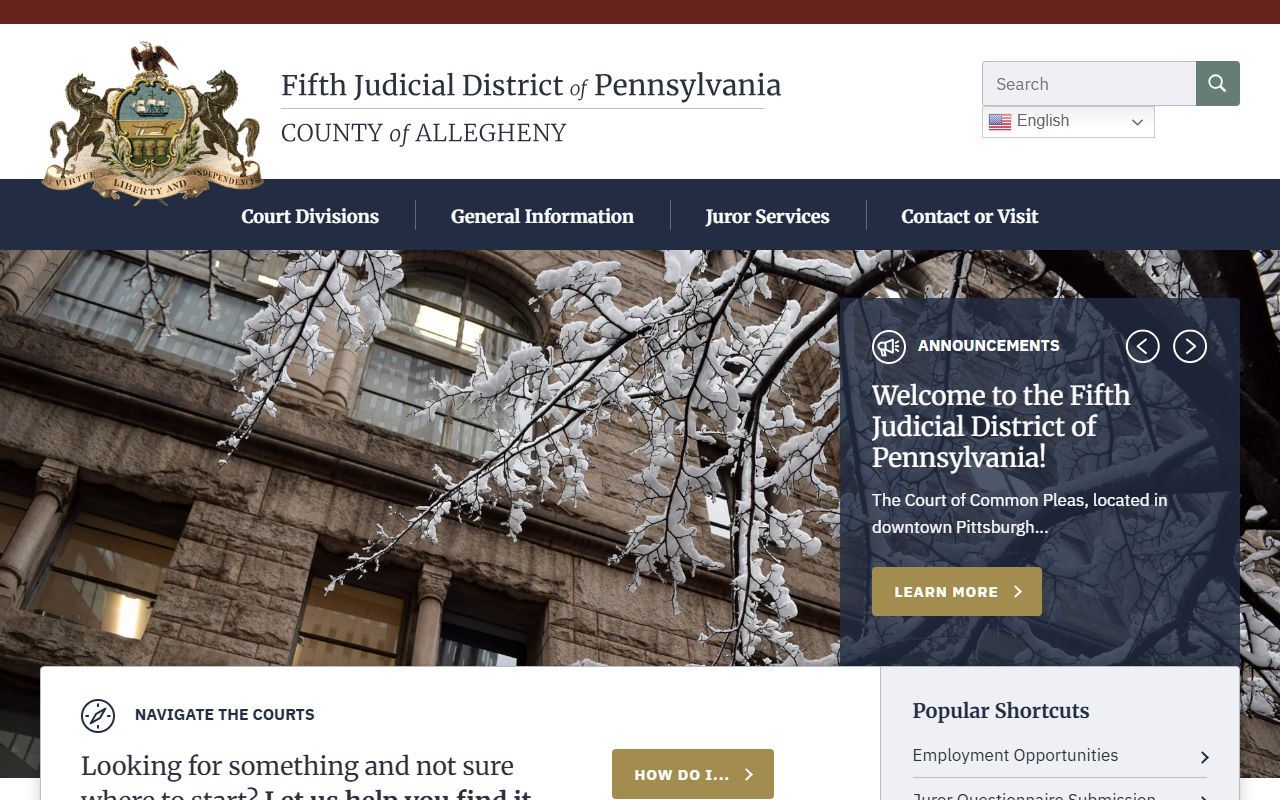
From that homepage you can reach the Civil, Criminal, Family, and Orphans' Court division pages. Pittsburgh Municipal Court sits at 660 First Avenue, a short walk from the Grant Street buildings.
Types of Court Records Available in Allegheny County
Allegheny County court records fall into a handful of groups, and each group comes from a different division. Civil records cover money and property disputes, arbitration, and housing matters. Criminal records track charges, pleas, and sentences. Family records hold divorce, custody, support, and protection cases. Orphans' Court records cover estates, wills, guardianships, and adoptions. Traffic and summary records come from the minor courts.
The county landing page for these records explains how the Department of Court Records is built and which division to ask. You can see it on the Allegheny County court records page.
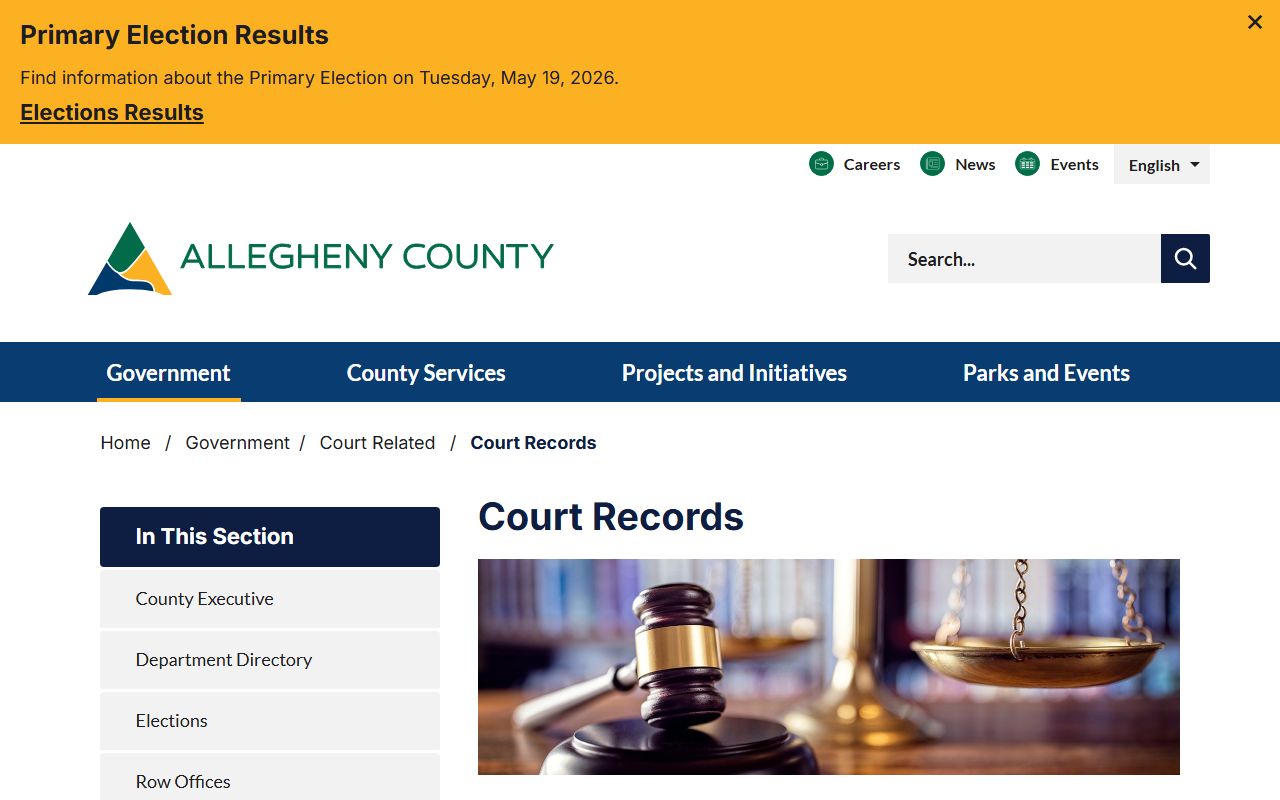
That page also notes that case files are public unless a judge seals them. Here are the main record types most people look for.
- Criminal records - dockets, charges, bail, pleas, and sentences from the Criminal Division.
- Civil records - complaints, judgments, arbitration awards, and housing matters up to and beyond the $50,000 arbitration ceiling.
- Family and divorce records - divorce, custody, support, and protection cases, with limited remote access.
- Orphans' Court records - estates, wills, guardianships, and adoptions.
- Traffic records - citations and summary cases from the minor courts.
What Allegheny County Court Records Show
A public docket in Allegheny County packs a lot into one screen. It names the court and the docket number, lists the parties and their lawyers, and tracks each event in the case. Criminal and summary dockets add charges, the statute and grade, the disposition, and any fines or costs. The same fields show up whether the case is in Common Pleas, a magisterial district court, or Pittsburgh Municipal Court, though the docket number format changes by court.
The county Civil Division page gives a sense of the civil side, from arbitration to the Board of Viewers. You can view it at the Allegheny County Civil Division page.
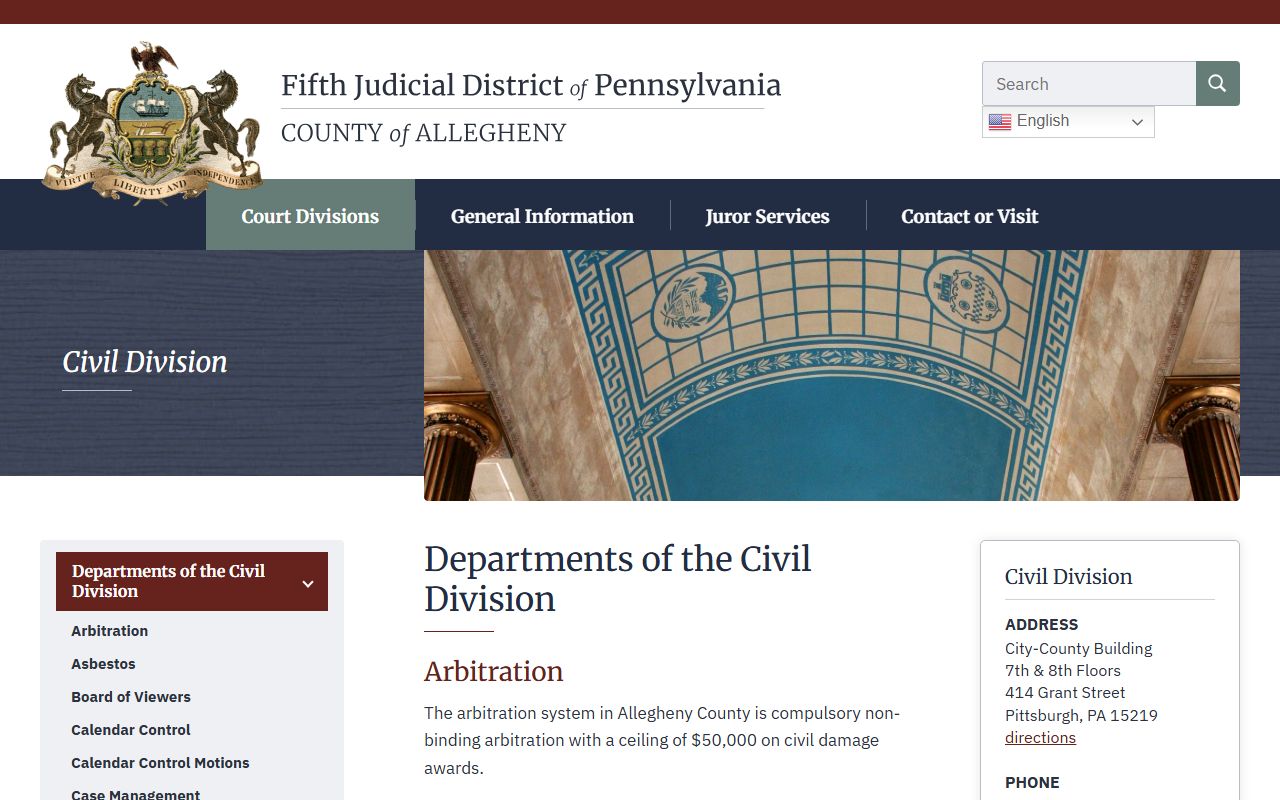
Civil dockets there track motions, judgments, and appeals from minor courts. The table below shows the common fields you will read on a docket sheet.
| Field | What It Shows |
|---|---|
| Docket Number | The court's case ID; CP-02 prefixes mark Common Pleas Allegheny County, MJ-05 marks a magisterial district court. |
| Filing Date | The date the complaint, petition, or citation was filed. |
| Parties | Plaintiff and defendant, Commonwealth and defendant, or petitioner and respondent. |
| Charges / Claims | Statute, grade, count, and offense date in criminal cases; the cause and amount in civil cases. |
| Disposition | The outcome: guilty, not guilty, dismissed, withdrawn, or a civil judgment. |
| Financial | Fines, costs, restitution, bail, and payment entries where they apply. |
Public Access Laws for Allegheny County Court Records
Court records in Pennsylvania are not handled like ordinary government files. The county open-records page tells people not to file a Right-to-Know form for a Common Pleas case file. Those files are public unless a judge seals them, and you request them from the right DCR division. General agency records follow the Right-to-Know Law, but court case access follows the judiciary's own policy and court rules. Criminal history sharing and expungement follow a separate state act.
Key Statutes:
204 Pa. Code § 213.81 - the Case Records Public Access Policy; sets what is open, what is confidential, and how remote access is limited.
65 P.S. §§ 67.101–67.3104 - the Right-to-Know Law for general agency records, with an Office of Open Records appeal path.
18 Pa.C.S. Ch. 91 - the Criminal History Record Information Act, which controls how criminal history is shared and sealed.
18 Pa.C.S. § 9122 - expungement, the legal removal of certain criminal records.
42 Pa.C.S. § 6307 - inspection of juvenile court files, which are restricted to listed people and agencies.
Records That Are Restricted or Confidential
Not every court record is open. Juvenile court files are restricted under state law to judges, parties, agencies, and other listed people. Adoption records are confidential and run through Orphans' Court. Family case files allow only docket-level remote access, so full divorce papers may need a DCR request. Mental health commitment records are sensitive, and so are victim, witness, and juror details in criminal cases.
Some filings always stay private. Social Security numbers, financial account numbers, driver's license numbers, and a minor's name and birth date must be filed on confidential forms, not in public documents. To view a sealed record, a person normally has to petition the court that sealed it and show legal grounds. The clerk's counter cannot lift a seal on its own.
Specialty Courts in Allegheny County
Allegheny County runs several problem-solving programs, mostly inside the Criminal Division and Adult Probation. Accelerated Rehabilitative Disposition, called ARD, is a diversion track for some first-time, non-violent cases. A clean ARD outcome can matter later for expungement. Eligibility is not automatic, though, because the offense type, prior record, and the District Attorney's policy all weigh in.
The Alcohol Highway Safety Program supports DUI cases through evaluations, an interlock program, and safety school. Bail Services runs a Bail Investigative Unit at the jail and a pretrial supervision unit, and the Behavior Assessment Unit reviews a defendant's competency. The county also joined the MacArthur Safety + Justice Challenge in 2018 to safely lower the jail population. These programs show up as entries and conditions on a criminal docket.
Allegheny County Sheriff and Jail
The Allegheny County Sheriff's Office is led by Sheriff Kevin M. Kraus, at 436 Grant Street, Room 111, in the courthouse. The office highlights fugitives wanted for violent crimes and asks the public to call with tips. It gives a firm rule on warrants: the office does not share warrant details by phone, and anyone who thinks they have a warrant must appear in person. The Sheriff's Office also does not run background checks and sends those questions to DCR.
The Allegheny County Jail is a high-rise, direct-supervision facility at 950 Second Avenue, opened in 1995, with capacity over 3,000. The county did not publish a verified public online inmate roster in this review, so booking and custody questions go through the jail by phone. For the roster routes and contacts, see Allegheny County inmate records, and for active warrants and the most wanted list, see warrant records.
The Criminal Division also runs Adult Probation, Pretrial Services, and Summary Appeals. You can view its services on the Allegheny County Criminal Division page.
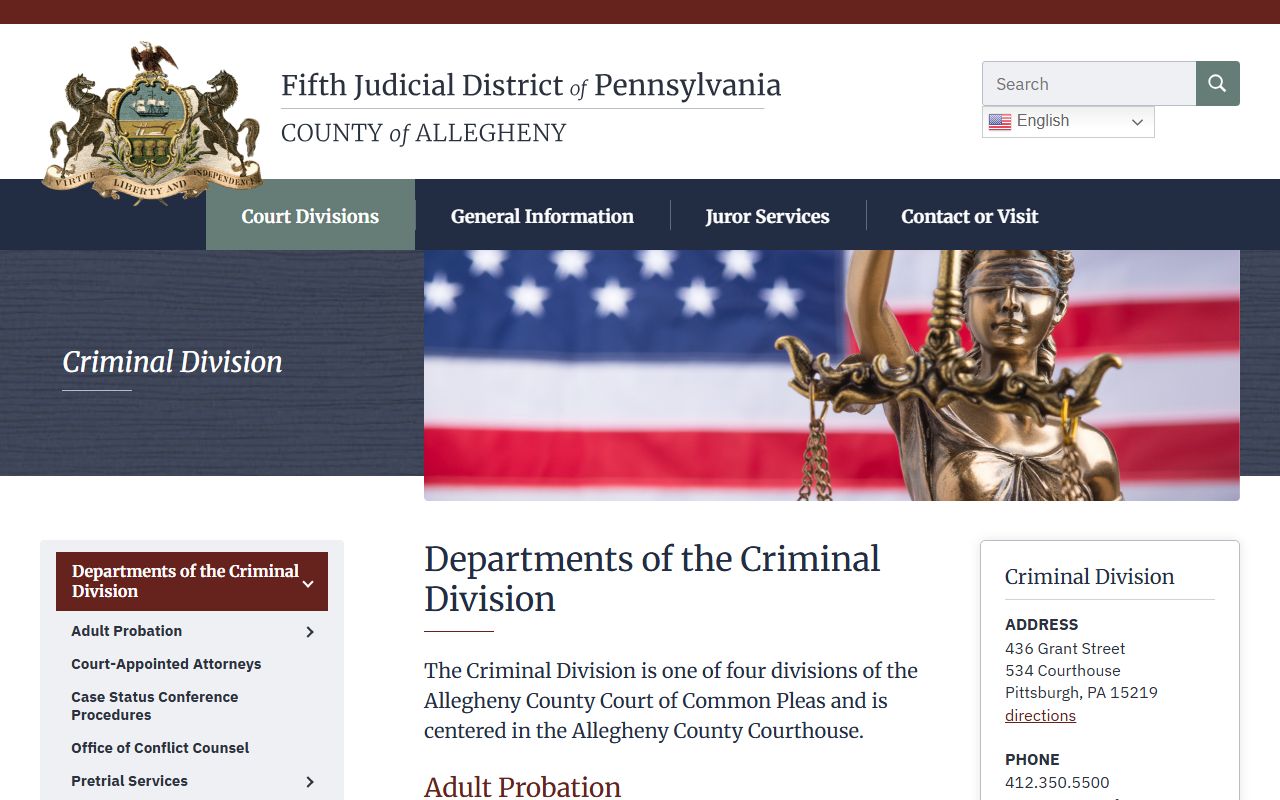
That page is where summary traffic appeals, bail, and probation contacts live. It ties the jail, the courts, and criminal records together.
Marriage, Divorce, and Orphans' Court Records
Marriage licenses come from the DCR Marriage License Section in the City-County Building. The fee is $90, and the license is issued after a three-day waiting period, then stays valid for 60 days. Divorce is a Family Division matter, and those files are kept by the DCR Civil/Family Division with limited remote access. For full details, see marriage and divorce records.
Estates, wills, and guardianships run through Orphans' Court and the DCR Wills/Orphans' Court Division. The full path, forms, and fees are on the Orphans' Court and probate records page. The county Family Division page covers custody, support, and dependency work.
That division handles divorce and custody filings. The Orphans' Court page below covers the estate and guardianship side.
You can reach it through the Allegheny County Orphans' Court page. A few terms come up again and again in these files.
- Testator
- A person who makes a will.
- Executor
- The person named in a will to settle the estate.
- Guardian
- A person the court names to make decisions for a minor or an incapacitated adult.
- Intestate
- Dying without a valid will, which sends the estate through a default legal process.
Allegheny County Court Records Fees
Fees depend on the office and the service. The county publishes separate fee schedules for civil, criminal, and Orphans' Court work. A few common, sourced fees are listed below. Always confirm the current amount with the office before you pay, because the county is changing several fees in 2026.
| Item | Amount |
|---|---|
| Marriage license application | $90 |
| Certified copy of a marriage record | $20 |
| Summary (traffic) appeal filing | $94, money order or cash |
| DCR records retention fee, per filing | $3.50; $7.00 from June 1, 2026 |
The summary appeal fee is non-refundable, and the office does not take personal checks. People who cannot pay may file an in forma pauperis petition to ask for a waiver.
How to Interpret Allegheny County Court Records
Reading a docket gets easier once you know a few terms. A charge is not a conviction. The disposition field is what tells you the result, so a guilty plea, a dismissal, or an acquittal all read differently from the charge itself. An OTN ties one person's charges together across the system. A bench warrant means a judge ordered an arrest, often for a missed court date. ARD and Clean Slate entries point to diversion or sealing, not a normal conviction.
Docket numbers also carry meaning. A CP-02 prefix is Common Pleas in Allegheny County, and an MJ-05 prefix is a magisterial district court. If a case looks federal, it will not be in the state tool at all; those go through the federal PACER system instead.
Accuracy and Record Limitations
Online dockets update on a delay, and data entry can lag a hearing by days. A recent plea or payment may not show right away. If a record looks wrong, the fix is to call the division that holds the case, not to rely on the screen.
Note: Confirm any name, date, or disposition with the originating DCR division before you rely on an online record for a legal, job, or housing decision.
History of Allegheny County Courts
The current courthouse is the county's third major courthouse generation. An earlier courthouse at Grant and Forbes burned in 1882. Henry Hobson Richardson designed the building that replaced it, and the Norcross Brothers built the courthouse and old jail in the 1880s. The complex became a leading example of the style later called Richardsonian Romanesque, and the old jail is now a National Historic Landmark tied to the Family Court buildings.
The court system itself is the Fifth Judicial District. Its modern shape includes the four Common Pleas divisions, 46 magisterial district courts, and Pittsburgh Municipal Court. Records technology keeps changing too, from mandatory attorney e-filing in 2023 to electronic case notices arriving in 2026.
Frequently Asked Questions
How do I search Allegheny County court records online?
Use the Pennsylvania UJS case search for most public dockets, including Common Pleas, magisterial district courts, Pittsburgh Municipal Court, and traffic cases. Set the county to Allegheny and search by name, docket number, citation number, or OTN. For copies of filed documents, use the county DCR portal or call the right division.
Which office keeps Allegheny County court records?
The Department of Court Records keeps Common Pleas records. It has Civil/Family, Criminal, and Wills/Orphans' Court divisions. Civil and family files run through the City-County Building, criminal files through the courthouse, and estate and marriage matters through Wills/Orphans.
Should I file a Right-to-Know request for a court file?
Usually no. The county says not to use the Open Records form for a Court of Common Pleas case file. Court files are public unless sealed by a judge, so you request them from the proper DCR division instead.
More on the Allegheny County Court Records FAQ page.