
Arrest Records in Allegheny County
An arrest record is created when police take a person into custody and book them. Booking captures the person's name, the date and time, the charges, and often a photo. In Allegheny County, arrests come from local police departments across the many boroughs and townships, the Allegheny County Police, and the Sheriff's Office. People committed by the courts are held at the Allegheny County Jail at 950 Second Avenue in Pittsburgh. The jail handles the custody side, while the charges move into the court system on a separate track.
An arrest record is not the same as a criminal court record, and neither one is a conviction. The arrest record marks the start. The court record begins when the prosecution files charges, and it tracks the case to its result. A conviction is only one possible outcome. Because of that split, full criminal court history for a person is best pulled from the court docket, not the booking sheet. For the full case file behind an arrest, see Allegheny County court records, which covers the docket search and the office that holds the papers.
Note: an arrest by itself proves nothing about guilt, since the charges still have to be proven in court.
How to Search Allegheny County Arrest Records
There is no single public arrest blotter for the whole county, so the search depends on what you know. To confirm a current custody or booking, the jail handles that by phone. To trace a charge into court, the Pennsylvania Unified Judicial System case search is the free public tool, because the docket shows the charges, the OTN, and the case events. Most people use both: the jail for the booking fact, the docket for the court side.
This research found no verified official public online jail roster on the county jail pages. The jail instead directs people to call. Use these steps to confirm an arrest and find the case.
- Call the Allegheny County Jail at 412-350-2000 to confirm a booking, pod, or custody status.
- Call Arraignment Court at 412-350-3240 for the booking date.
- Open the Pennsylvania UJS case search and search by participant name, choosing Allegheny County.
- Write down the docket number and the OTN from the result, then read the charges and events.
For a statewide criminal history rather than one case, Pennsylvania State Police resources are the proper channel. A UJS docket shows one case at a time. A criminal history record is a separate, regulated product, and it is the right tool for screening, not a casual docket lookup.
Arrest Records vs. Criminal Court Records
People mix these up, but they come from different offices and cover different stages. The arrest record is the booking event. The criminal court record is the case that follows once charges are filed. One is held by police and the jail. The other is held by the court through the Department of Court Records.
| Arrest Record | Criminal Court Record | |
|---|---|---|
| Source | Police, county police, Sheriff, and county jail | Court of Common Pleas through the Department of Court Records |
| Created When | At booking, when a person is taken into custody | When the Commonwealth files charges |
| Contents | Booking data, charges, custody status, photo | Docket, motions, pleas, disposition, sentence |
| Where to Get It | Call the jail; OTN links it to the case | UJS case search, then the Criminal Division for copies |
The OTN, or Offense Tracking Number, is the thread that ties the two together. It links one person's charges from the arrest through the court process. If you have the OTN or the docket number, you can pull the case quickly. For the full criminal court history, the court docket is the better record, since the booking sheet only shows the start.
Charges vs. Convictions
A charge is an accusation. A conviction is a result. The gap between them matters, because an arrest record may show charges that were later dropped, reduced, or thrown out. Reading the disposition field on the court docket is the only way to know how a charge ended.
| Charge | Conviction | |
|---|---|---|
| Stage | Accusation at or after arrest | Guilty plea or verdict in court |
| Burden of Proof | Probable cause | Beyond a reasonable doubt |
| Public Record | Yes, on the arrest and court docket | Yes, in the disposition on the docket |
| Possible Outcomes | Dropped, reduced, dismissed, ARD, or proven | Sentence, probation, fines, or appeal |
Pennsylvania has a diversion track called Accelerated Rehabilitative Disposition, or ARD. It supervises some first-time, non-violent cases, and a clean ARD outcome can open the door to expungement later. ARD is not a conviction, but it is also not an automatic dismissal. Eligibility depends on the offense, the prior record, restitution, and the District Attorney's policy.
Sealed vs. Expunged Records
Pennsylvania treats sealing and expungement as two different forms of relief. Sealing, often called limited access or Clean Slate, hides a record from public view while leaving it intact for criminal justice use. Expungement removes the record under statute or court order. The rules sit in the Crimes Code, and the difference decides who can still see the record.
| Sealed | Expunged | |
|---|---|---|
| Visibility | Hidden from public access | Removed and destroyed under the order |
| Law Enforcement | Still accessible for criminal justice use | Very limited; some lists may be kept |
| Pennsylvania Path | Limited access or Clean Slate automatic sealing | Petition under 18 Pa.C.S. § 9122 |
| Eligibility | Eligible records after statutory conditions are met | No disposition after 18 months, nonconviction data, pardon, or acquittal |
The expungement statute spells out the categories. The clearest summary is the law itself, which lists when a record can be wiped.
You can read the controlling rule at the official text for 18 Pa.C.S. § 9122 expungement. The page lists each ground, including no disposition after 18 months with certification, court-ordered nonconviction data, an unconditional pardon, certain underage drinking convictions, and acquittal procedures.
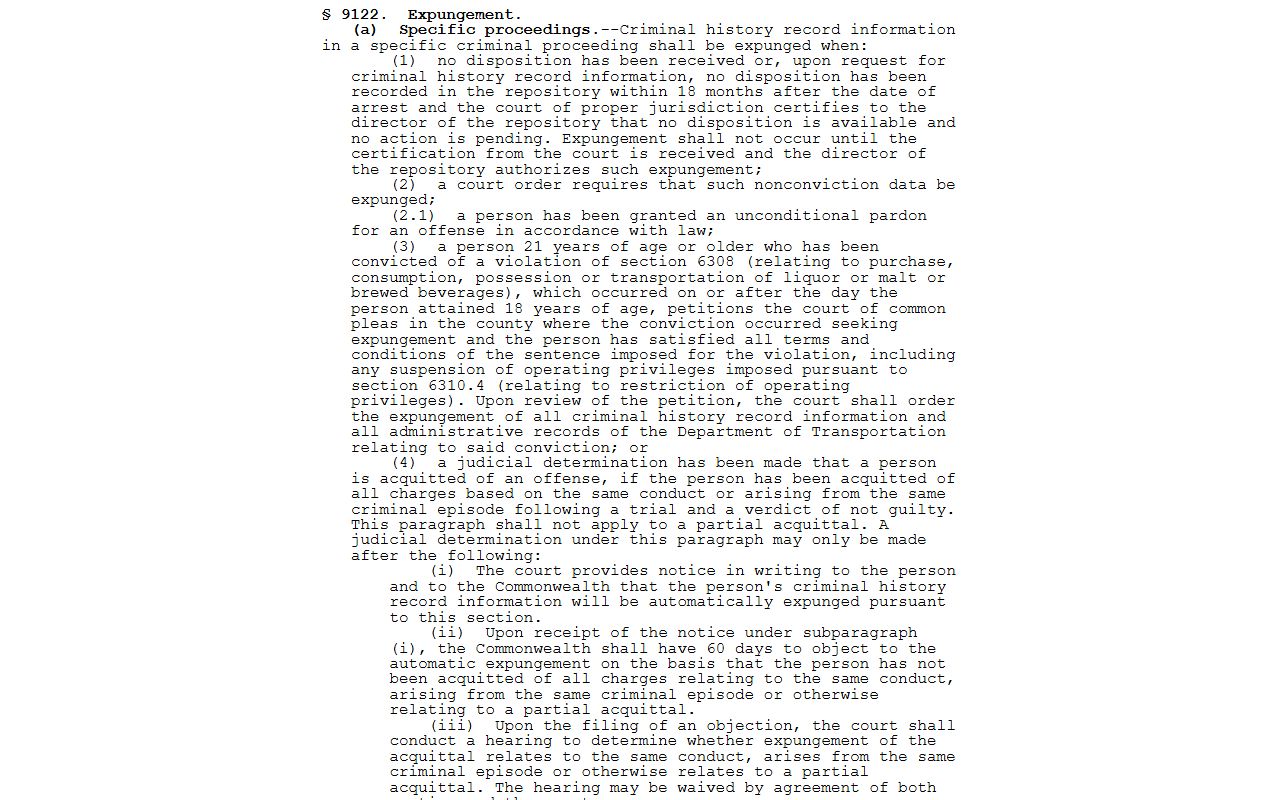
That statute controls Pennsylvania arrest and conviction records, not out-of-state or federal records. Act 36 of 2023 amended several of its provisions, so the eligibility rules have shifted in recent years.
How to Expunge an Allegheny County Arrest Record
Expungement in Pennsylvania starts at the state level and finishes at the county. The Pennsylvania State Police hold the central criminal history repository, so the first step is to get your own record from them. After that, you petition the county where the arrest happened. The process takes paperwork, a small fee, and patience.
- Complete Form SP 4-170, the Request for Access and Review.
- Mail it to the State Police Central Repository with a $20 certified check or money order and a copy of your government-issued photo ID.
- Wait for the State Police to mail back your full arrest record.
- Petition the county Clerk of Courts where the arrest occurred to expunge the record.
- Once the State Police get a signed court order, they expunge the record.
The dissemination and expungement rules live in the Criminal History Record Information Act, known as CHRIA. The full title table is the best official map of those sections.
You can browse the statute at the official Pennsylvania Crimes Code Title 18 page, which links CHRIA, dissemination, expungement, limited access, and juvenile-record provisions.
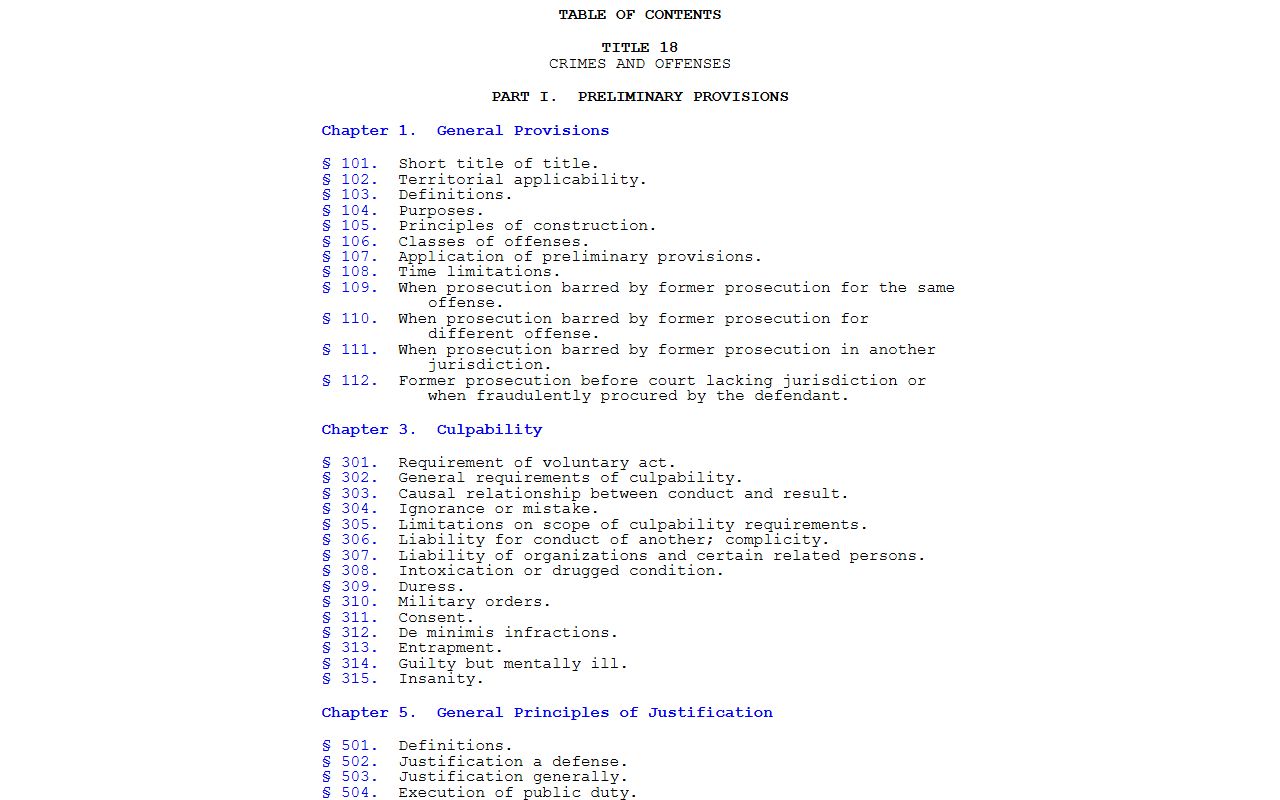
That title table covers how criminal history is collected, shared, sealed, and expunged across the state. The county Clerk of Courts step is where an Allegheny County arrest finally clears once the order is signed.
The State Police also publish their own walkthrough of the access-and-review and expungement process. It restates the SP 4-170 step and the mailing requirements in plain terms.
You can follow the official steps on the Pennsylvania State Police expungement process page. It is the same SP 4-170 route, with the $20 fee and the photo ID requirement laid out by the agency that holds the record.
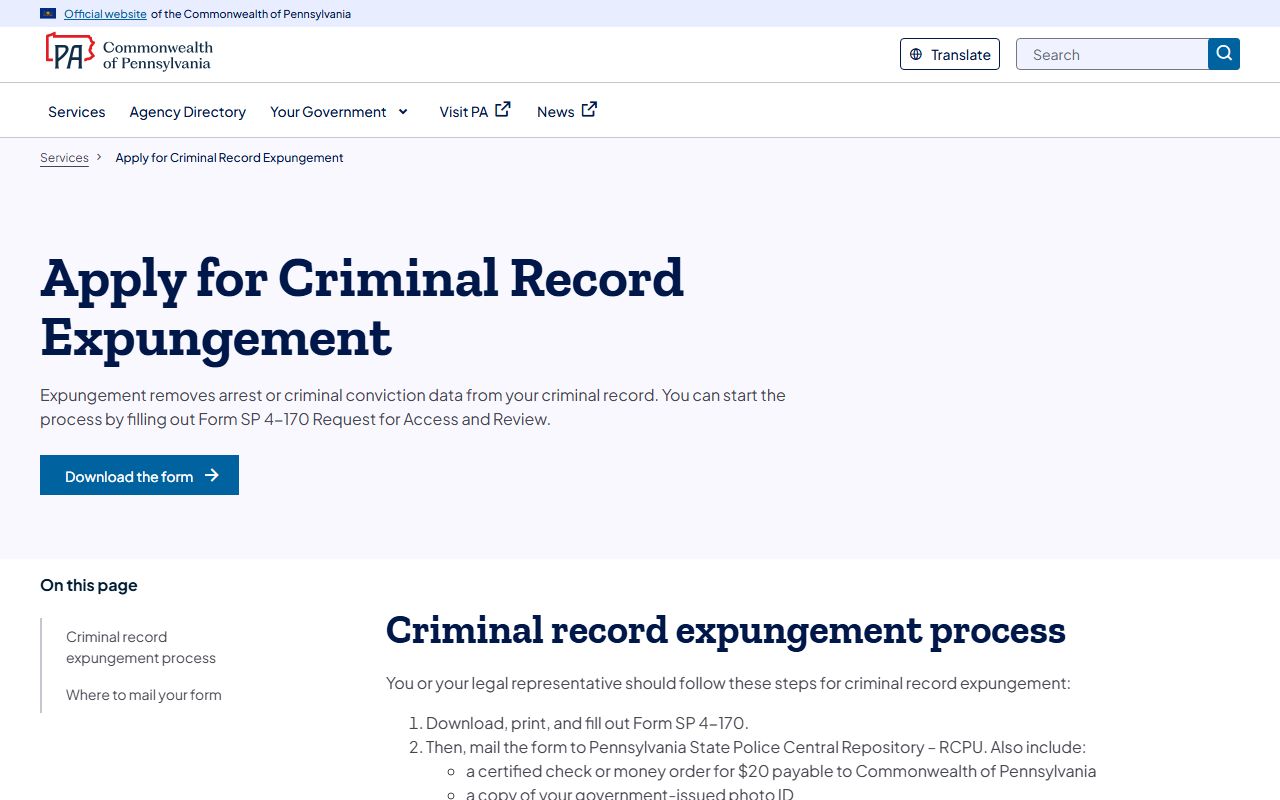
That page is the practical starting point. Expungement is not automatic, and it does not reach federal records, so an out-of-state or federal matter needs a different channel.
Mugshots and Booking Photos
A mugshot is the booking photo taken when a person is processed into custody. In Allegheny County, booking photos are part of the jail and police booking process, not a public gallery on the county jail pages found in this research. Because the county does not publish a current online inmate roster, there is no official county photo lookup tied to it. The Sheriff's Office does publish photos for its Most Wanted fugitives, but that is a narrow list of people wanted for violent crimes, not a general booking gallery.
Treat third-party mugshot sites with care. They are not official, the data can be stale, and a posted photo says nothing about how the case ended. The reliable path is the court docket, which shows the charges, the disposition, and whether a charge was dropped or reduced. For active fugitive listings and the rule about appearing in person, see Allegheny County warrant records.
Background Checks and Criminal Records
A docket lookup and a background check are not the same product. A UJS docket shows one case. A formal criminal history background check is a regulated record from the Pennsylvania State Police repository, governed by CHRIA. Anyone screening for a job, a rental, or a license should use the proper channel, not a single docket or a mugshot site. CHRIA also limits how an employer may use criminal records, so the rules cut both ways.
Important: Allegheny County Court Records is a private resource, not a consumer reporting agency under the FCRA, and its records may not be used for credit, employment, tenant, or insurance screening.
Restricted Arrest and Criminal Records in Allegheny County
Some criminal records are not open to the public. Juvenile court files are restricted under 42 Pa.C.S. § 6307 to judges, parties, counsel, custodial agencies, and other listed officials. Certain serious delinquency information can be public, but the default for juvenile records is closed. Sealed records and grand jury materials are also off-limits, and confidential identifiers like Social Security and driver's license numbers are redacted from public filings.
Records that were expunged or placed under limited access drop out of public view as well. So a person's public arrest history can look different from their full file held by criminal justice agencies. For DUI and other charges that cross into traffic court, see Allegheny County traffic court records, since a DUI generates both a criminal record and a driver-record consequence.